Guide
Robot mowers for multiple lawns, narrow passages and complex gardens
Front and back lawns, a path down the side of the house, trees, beds and awkward corners: how each type of robot mower copes with a complicated garden, what the zone and passage specs mean, and what to measure before you buy.

A "complex" garden is anything a robot mower can't treat as one open rectangle. The common UK examples are a front and back lawn joined by a side passage, a lawn broken up by beds, trees and a pond, a garden on several levels joined by a path or ramp, and a plot where half the lawn sits under mature trees or next to a tall house. None of these rules out a robot mower, but they change which kind you should buy, and they usually mean you need more rated area than the lawn size alone suggests.
This guide explains the specs that matter and how each navigation type deals with them. If you're new to the terminology, start with how robot lawn mowers work and the navigation types explained.
What makes a garden "complex"
Four things cause most of the trouble:
- Separate areas. Two or more lawns, joined by a path, passage or gate, or not joined at all.
- Narrow links. Gaps between lawn areas that are only a little wider than the mower.
- Clutter. Beds, trees, trampolines, washing lines, play equipment and garden furniture that break up the lawn.
- Poor sky view. Trees, tall hedges and buildings that block satellite signals, which matters for RTK mowers.
Slopes are the fifth, and they're covered in robot mowers on slopes.
The specs that matter
Minimum passage width
The minimum passage width is the narrowest gap the manufacturer says the mower can drive through. It varies a lot between models. Mammotion quotes 55 cm for the YUKA mini 2 and 68 cm for the LiDAR version of the LUBA mini 2 AWD. Gardena gives 60 cm for the wired SILENO city. At the other end, Segway Navimow quotes 100 cm for the i-series and Bosch 120 cm for the camera-guided VISIMOW. Many manufacturers don't publish a figure at all; if yours doesn't, ask before you buy.
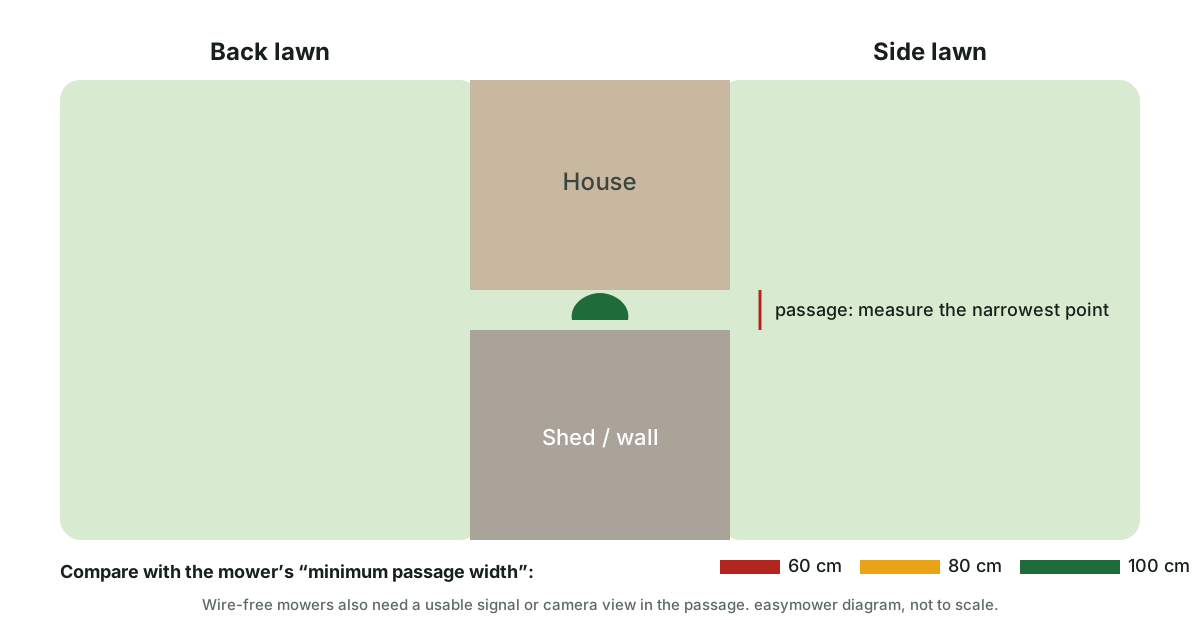
Measure your narrowest point with everything that's normally there: wheelie bins, a downpipe, the hinge side of an open gate, plants that flop over the path in June. A published figure is a best case on a flat, clear route. If your gap is within about 10 cm of it, expect the mower to hesitate or need help, especially if the passage also has a step, a kerb or a change of surface.
Zones and maps
Zones are areas on one map that the mower can treat separately. The limits vary from a handful on simpler machines to dozens or more on large-garden models: Gardena's SILENO city manages 4, Mammotion's LUBA 2 AWD 30–100 depending on version, and Segway Navimow's X4 up to 120. For most gardens the number matters less than how easy the app makes it to link zones, schedule them separately and set different cutting heights.
Multi-map is different. It means the app can store separate maps for areas that aren't connected, such as a front garden and a back garden on either side of a house with no side access. You carry the mower between them. Check whether the second area also needs its own charging station, or RTK coverage, to work properly.
Rated area, adjusted for complexity
A mower spends time driving between zones, turning round obstacles and edging round beds, so a divided lawn takes longer to cut than an open one of the same size. The usual advice is to choose a rated area at least 20% above your lawn; for a garden with several zones and a lot of clutter, 40–50% headroom is more comfortable. Our lawn size tool helps you measure each area.
How each navigation type copes
Perimeter wire
A perimeter wire mower only knows where the wire is. In a simple garden that's fine; in a divided one it needs help. Wired mowers from Husqvarna, Gardena, Flymo and others handle separate areas in two main ways:
- Guide wires. A guide wire runs from the charging station through the passage to the far lawn. The mower follows it out to start mowing there and back again to charge. Manuals set rules for how close the guide wire can be to the perimeter wire, which effectively sets the narrowest passage the mower can use.
- Secondary areas. A lawn that isn't linked at all gets its own loop of perimeter wire from the same charging station, and you carry the mower there. It mows until the battery runs low and waits to be carried back.
Wired mowers are predictable once installed and don't care about trees or buildings. The cost is the installation itself: every bed, tree and pond inside the lawn needs its own wire island, and changes later mean moving wire. See perimeter wire vs wire-free for the full trade-off.
RTK and network RTK
RTK mowers know their position to within a few centimetres, so they can mow in straight lines, link zones with a drawn channel through a passage, and avoid beds you draw as no-go zones in the app. That flexibility makes them attractive for divided gardens.
The weakness is sky view. A side passage between a house and a fence is exactly where satellite signals are weakest, and lawns under mature trees can be patchy too. The mower may slow down, pause or stop until it gets a fix again.
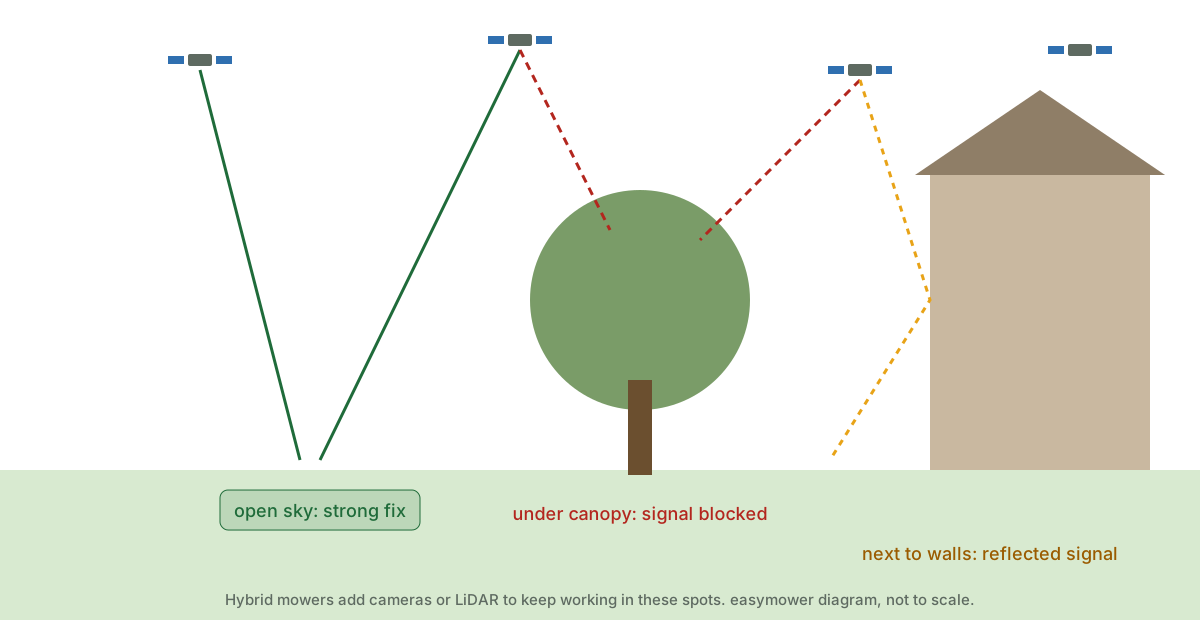
If your garden has these spots, look for a mower that fuses RTK with another sensor. Many current models do: Segway Navimow's X4 combines network RTK with cameras, and Husqvarna's V-series NERA models pair satellite positioning with an AI camera. Some ranges go the other way: Mammotion's LUBA mini 2 AWD 1500 drops RTK altogether and relies on LiDAR and cameras. Manufacturers describe these combinations as designed for exactly this problem, though how well they work depends on the garden. Our network RTK and 4G guide covers the signal side in more detail.
LiDAR and vision
LiDAR and camera mowers work best where there are fixed features to see: walls, fences, sheds and hedges. That makes them well suited to built-up, divided gardens and narrow passages, which are the places RTK struggles. Their weak spots are the opposite: large open lawns with little to see, and (for cameras) lawn edges that blend into gravel, paving or meadow planting without a clear line.
Some camera mowers also need good light and a visible edge. If your lawn runs into a border of long grass or wildflowers with no path or edging, check what the manufacturer says about boundary detection before you rely on it.
Getting between areas
Whatever the navigation, the route between lawns needs to be mowable, or at least drivable:
- Surfaces. Most wire-free mowers can drive across short stretches of paving, a patio or a gravel path if you draw a channel over it. Loose gravel, deep bark and wet decking are harder. Check the manual, and keep blades off hard surfaces where the app allows.
- Steps and kerbs. Robot mowers can't climb steps. Some manufacturers publish a maximum obstacle height, usually a few centimetres; a ramp or a filled edge solves most kerbs.
- Gates. A mower can't open a gate. Either leave it open on mowing days or schedule the far lawn only when it's open.
- Slopes in passages. A slope that's fine on open grass may be harder in a narrow passage where the mower can't turn across it. Allow a margin below the rated slope.
Checklist before you buy
- Sketch the garden and measure each lawn area separately.
- Measure the narrowest gap between areas with bins and plants in place.
- Note which areas are under trees or within a few metres of a tall building.
- Decide which areas can be linked by driving and which need carrying.
- Look for a published passage width, zone limit and multi-map support that fit your sketch.
- Add 40–50% to your total lawn area for a heavily divided garden when choosing a rated area.
- Work out where the charging station and any RTK antenna could go, with power and sky view.
For shortlists of models that suit this kind of garden, see our best robot mowers for complex gardens. If one lawn is much bigger than the other and they aren't linked, compare the cost of two small mowers against one large one before you decide.
Frequently asked questions
Can one robot mower cut a front and a back lawn?
Yes, if it can get between them or you're happy to carry it. If a side passage, gate or path links the lawns and is wider than the mower's stated minimum passage width, most wire-free mowers can be set to drive between zones. If the lawns aren't connected, you'll need a mower that stores more than one map and you'll move it by hand.
What passage width do I need for a robot mower?
At least the manufacturer's stated minimum passage width, plus a margin. Current models range from about 55 cm to over a metre. Measure the narrowest point, including overhanging plants, bins and gate posts, and treat anything within 10 cm of the stated minimum as tight.
Do wire-free mowers work in a narrow side passage?
It depends on the navigation. RTK mowers can lose accuracy between a house and a fence because the walls block part of the sky. Mowers that add LiDAR or cameras usually cope better, because those sensors work best where there are walls to see.
How many zones do I need?
One per separate lawn area, plus any you want on a different schedule or cutting height. Most gardens need fewer than ten. Very high zone counts matter mainly for large, heavily divided plots.
Should I buy two mowers instead of one?
Sometimes. If your two lawns aren't linked and are both a decent size, two small mowers can be simpler than carrying one back and forth, and each keeps its own charging station. Compare the total cost with one larger mower before deciding.
In this guide
Models mentioned in this guide
With today’s lowest UK price and our score.
 Mammotion
Mammotion YUKA mini 2
- Up to 1,000 m²
- Hybrid (RTK + vision/LiDAR)
- 45% slopes
MammotionMammotion LUBA mini 2 AWD
- Up to 1,500 m²
- Hybrid (RTK + vision/LiDAR)
- 80% slopes

Segway Navimow X4 Series
- Up to 5,000 m²
- Hybrid (RTK + vision/LiDAR)
- 84% slopes

GARDENA SILENO city
- Up to 500 m²
- Perimeter wire
- 35% slopes

Worx Landroid Vision Cloud
- Up to 1,800 m²
- Hybrid (RTK + vision/LiDAR)
- 30% slopes

Husqvarna Automower 430X NERA
- Up to 4,800 m²
- Network RTK
- 50% slopes
Mower finder
Not sure which mower fits your garden?
Tell us your lawn size, slopes, trees and budget. The finder filters every current model down to the ones that fit, and explains why.
Measure your lawn on a map