Buying guide
The best robot lawn mowers in the UK
We compare every robot lawn mower currently sold in the UK using manufacturer specifications, UK warranty terms and live retailer prices. Our picks below are desk-based judgements, not hands-on reviews: we haven't tested these mowers yet, and we say so on every page. Under the picks you'll find a full comparison table and a buying guide written for UK gardens, with their trees, walls, wet springs and patchy mobile signal.

Our picks
The short answer
One pick for each kind of garden and budget, with the trade-off we'd want to know about before buying.
Best overall
Mammotion LUBA mini 2 AWD
- Up to 1,500 m²
- Hybrid (RTK + vision/LiDAR)
- 80% slopes
No wire and no base station, all-wheel drive with an 80% slope rating, full edge cutting, a three-year warranty and three years of 4G data included. It covers more UK garden types than anything else near its price.
Trade-off The two sizes navigate differently: the 1000 relies on network RTK and cameras, the 1500 on LiDAR and cameras. Pick by layout, and look elsewhere if your lawn is over about 1,200 m².
Best value
Segway Navimow i2 LiDAR
- Up to 2,000 m²
- LiDAR
- 45% slopes
LiDAR navigation that doesn't depend on satellite signal, rated for up to 2,000 m², a 220 mm cut, built-in 4G and a three-year warranty, at a price that undercuts most wire-free rivals of similar rated area.
Trade-off Two-wheel drive with a 45% slope limit, and LiDAR needs walls, fences or other fixed features in range, so very open lawns are a weaker fit.
Best for large gardens
Segway Navimow X4 Series
- Up to 5,000 m²
- Hybrid (RTK + vision/LiDAR)
- 84% slopes
The X450 is rated for 5,000 m² with a very wide 430 mm cut, four-wheel drive, an 84% slope rating and a fusion of RTK, cameras and time-of-flight sensing that doesn't need a base station.
Trade-off Sold through dealers and retailers rather than Navimow's own UK store, and Navimow says the 84% slope figure was achieved under manual remote control.
Best wire-free under £1,000
Ecovacs GOAT O1200 LiDAR PRO
- Up to 1,200 m²
- LiDAR
- 45% slopes
LiDAR navigation with no RTK station to site, a built-in edge trimmer for a full cut along borders and a three-year warranty, rated for 1,200 m² with an RRP under £1,000.
Trade-off No 4G, so no remote tracking if it's stolen, and every UK GOAT was out of stock at the end of the 2026 season. Check availability before you plan around it.
Best budget
Worx Landroid M
- Up to 500 m²
- Perimeter wire
- 35% slopes
A simple boundary-wire mower from a brand with wide UK retail distribution, with a Wi-Fi app, a rain sensor and optional add-on modules for obstacle avoidance and theft tracking.
Trade-off You have to lay a wire, it's rated for only 500 m² and 35% slopes, and the warranty is two years (three if you register). Cheaper wired mowers exist if you don't need the app.
Best wired
Honda Miimo HRM 1000 to 4000
- Up to 4,000 m²
- Perimeter wire
- 47% slopes
A five-year domestic warranty, the longest standard cover of any current range in our catalogue, plus a 47% slope rating and sizes from 1,000 m² to 4,000 m². The Live versions add built-in 4G and GPS theft tracking.
Trade-off It needs a boundary wire, the non-Live models are Bluetooth only, and the five years depend on dealer registration and servicing to Honda's schedule. Honda's manuals also give recommended areas below the headline figures.
Live prices
Every current robot mower compared
Live prices from UK retailers where we have them, otherwise the manufacturer’s RRP. Tap a column heading to sort.
| Model | Price from | Max lawn | Navigation | Max slope | Score |
|---|---|---|---|---|---|
 Anthbot Genie Anthbot Genie | – | 3,600 m² | Hybrid (RTK + vision/LiDAR) | 45% | 7.9 |
| Anthbot M5 | – | 500 m² | Hybrid (RTK + vision/LiDAR) | 45% | 7.9 |
| Anthbot M9 | – | 1,000 m² | Hybrid (RTK + vision/LiDAR) | 45% | 7.9 |
 Ambrogio 4.0 Elite Ambrogio 4.0 Elite | £2,719.20 | 6,500 m² | Perimeter wire | 60% | 7.1 |
| Ambrogio L60 Elite | £899 | 400 m² | – | 50% | 5.3 |
| Ambrogio Twenty | £1,249 | 3,500 m² | Perimeter wire | 45% | 6.4 |
| Ambrogio Twenty ZR | £1,249.17 | 1,000 m² | – | 45% | 6.0 |
 Bosch VISIMOW18V Bosch VISIMOW18V | £299.98 | 200 m² | Vision (camera) | 35% | 5.7 |
 Dreame A1 Pro Dreame A1 Pro | £699 | 2,000 m² | LiDAR | 45% | 8.1 |
 Ecovacs GOAT O RTK (O600 RTK / O800 RTK) Ecovacs GOAT O RTK (O600 RTK / O800 RTK) | £449 | 800 m² | RTK (own base station) | 45% | 7.5 |
| Ecovacs GOAT O1200 LiDAR PRO | £949 | 1,200 m² | LiDAR | 45% | 7.9 |
| Ecovacs GOAT O500 Panorama | £799Out of stock | 500 m² | Hybrid (RTK + vision/LiDAR) | 45% | 7.4 |
 Einhell FREELEXO Einhell FREELEXO | £309.98 | 500 m² | Perimeter wire | 35% | 6.2 |
| Einhell FREELEXO CAM | £579.95 | 500 m² | Vision (camera) | 25% | 6.4 |
| Einhell FREELEXO LCD BT | £752.95Out of stock | 1,200 m² | Perimeter wire | 35% | 6.4 |
 Flymo EasiLife Flymo EasiLife | £644.98Out of stock | 800 m² | Perimeter wire | 35% | 6.0 |
| Flymo EasiLife GO | £419 | 500 m² | Perimeter wire | 25% | 6.0 |
| Flymo UltraLife | £659.86 | 1,500 m² | Perimeter wire | – | 6.8 |
 GARDENA SILENO city GARDENA SILENO city | £1,199 | 500 m² | Perimeter wire | 35% | 6.7 |
| GARDENA SILENO life | £1,329.95Out of stock | 1,250 m² | Perimeter wire | 35% | 6.8 |
| GARDENA SILENO minimo | £429 | 500 m² | Perimeter wire | 25% | 5.9 |
| GARDENA smart SILENO free | £1,299 | 1,200 m² | Network RTK | 35% | 7.4 |
| GARDENA smart SILENO sense | £999 | 600 m² | Hybrid (RTK + vision/LiDAR) | 25% | 7.9 |
 Honda Miimo 1500i and 2200i Honda Miimo 1500i and 2200i | £2,075RRP | 2,200 m² | Network RTK | 47% | 6.7 |
| Honda Miimo HRM 1000 to 4000 | £474 | 4,000 m² | Perimeter wire | 47% | 6.7 |
| Honda Miimo HRM 40 and 70 | £849 | 700 m² | Perimeter wire | 27% | 5.7 |
 Husqvarna Automower 305 Husqvarna Automower 305 | £699 | 600 m² | Perimeter wire | 40% | 5.7 |
| Husqvarna Automower 305E NERA | £1,549 | 900 m² | Network RTK | 30% | 6.4 |
| Husqvarna Automower 308V | £1,249 | 800 m² | Hybrid (RTK + vision/LiDAR) | 40% | 7.1 |
| Husqvarna Automower 310 Mark II | £699 | 1,000 m² | Perimeter wire | 40% | 6.3 |
| Husqvarna Automower 310E NERA | £1,949 | 1,500 m² | Network RTK | 30% | 6.7 |
| Husqvarna Automower 312V | £1,499 | 1,200 m² | Hybrid (RTK + vision/LiDAR) | 40% | 7.2 |
| Husqvarna Automower 315 Mark II | £799 | 1,500 m² | Perimeter wire | 40% | 6.5 |
| Husqvarna Automower 320 NERA | £2,499 | 3,300 m² | Network RTK | 50% | 7.2 |
| Husqvarna Automower 405VE NERA | £2,299 | 900 m² | Hybrid (RTK + vision/LiDAR) | 30% | 7.4 |
| Husqvarna Automower 405X | £999 | 600 m² | Perimeter wire | 40% | 6.0 |
| Husqvarna Automower 410VE NERA | £2,849 | 1,500 m² | Hybrid (RTK + vision/LiDAR) | 30% | 7.6 |
| Husqvarna Automower 410XE NERA | £1,919.20 | 1,000 m² | Perimeter wire | 30% | 6.4 |
| Husqvarna Automower 415X | £899 | 1,500 m² | Perimeter wire | 40% | 7.0 |
| Husqvarna Automower 430V NERA | £3,799 | 4,800 m² | Hybrid (RTK + vision/LiDAR) | 50% | 8.0 |
| Husqvarna Automower 430X NERA | £3,299 | 4,800 m² | Network RTK | 50% | 7.6 |
| Husqvarna Automower 435X AWD NERA | £4,769.10 | 5,000 m² | Network RTK | 70% | 7.5 |
| Husqvarna Automower 450V NERA | £4,898 | 7,500 m² | Hybrid (RTK + vision/LiDAR) | 50% | 8.3 |
| Husqvarna Automower 450X NERA | £3,599.20 | 7,500 m² | Network RTK | 50% | 7.8 |
| Husqvarna Automower Aspire R6V | £999 | 600 m² | Hybrid (RTK + vision/LiDAR) | 40% | 7.1 |
 Kress EyePilot 4×4 RTKn Kress EyePilot 4×4 RTKn | £1,749 | 10,000 m² | Hybrid (RTK + vision/LiDAR) | 84% | 8.4 |
| Kress EyePilot RTKn | £1,069 | 10,000 m² | Hybrid (RTK + vision/LiDAR) | 40% | 8.2 |
| Kress Mission | £549RRP | 2,500 m² | Perimeter wire | 35% | 6.6 |
| Kress Mission Mega | £1,749RRP | 6,500 m² | Perimeter wire | 45% | 7.0 |
| Kress Mission RTKn | £674.50 | 5,000 m² | Network RTK | 40% | 7.4 |
 LawnMaster OcuMow 16 LawnMaster OcuMow 16 | £229.99 | 300 m² | Vision (camera) | 35% | 5.9 |
| LawnMaster OcuMow 18 | £499.99 | 800 m² | Vision (camera) | 35% | 6.9 |
| LawnMaster OcuMow AMB16 | £379.99 | 600 m² | Vision (camera) | 35% | 6.8 |
 Lymow One Plus Lymow One Plus | £2,799Out of stock | 7,001 m² | Hybrid (RTK + vision/LiDAR) | 100% | 8.1 |
 MammotionMammotion LUBA 2 AWD MammotionMammotion LUBA 2 AWD | £1,699 | 10,000 m² | Hybrid (RTK + vision/LiDAR) | 80% | 8.8 |
| MammotionMammotion LUBA 3 AWD | £1,999 | 5,000 m² | Hybrid (RTK + vision/LiDAR) | 80% | 8.8 |
| MammotionMammotion LUBA mini 2 AWD | £1,249 | 1,500 m² | Hybrid (RTK + vision/LiDAR) | 80% | 8.0 |
| MammotionMammotion YUKA mini 2 | £799 | 1,000 m² | Hybrid (RTK + vision/LiDAR) | 45% | 7.8 |
 Segway Navimow H2 Series Segway Navimow H2 Series | £1,499 | 3,000 m² | Hybrid (RTK + vision/LiDAR) | 45% | 8.3 |
| Segway Navimow X4 Series | £2,199 | 5,000 m² | Hybrid (RTK + vision/LiDAR) | 84% | 8.8 |
| Segway Navimow i Series (i1) | £699 | 800 m² | Hybrid (RTK + vision/LiDAR) | 30% | 7.2 |
| Segway Navimow i2 AWD | £799 | 1,000 m² | Network RTK | 45% | 7.3 |
| Segway Navimow i2 LiDAR | £999 | 2,000 m² | LiDAR | 45% | 8.2 |
| Segway Navimow i2 LiDAR Pro | £1,199 | 2,000 m² | Hybrid (RTK + vision/LiDAR) | 55% | 8.1 |
 Parkside (Lidl) Parkside 20V Robot Lawnmower (PMRA 20-Li) Parkside (Lidl) Parkside 20V Robot Lawnmower (PMRA 20-Li) | £149.99RRP | 500 m² | Perimeter wire | 47% | 6.5 |
 STIGA A v range (A 6v to A 25v) STIGA A v range (A 6v to A 25v) | £999 | 2,500 m² | Network RTK | 45% | 7.7 |
| STIGA A v range large (A 50v to A 140v) | £2,999 | 14,000 m² | Network RTK | 50% | 8.5 |
| STIGA A-series (A 4 to A 1500) | £899 | 2,500 m² | RTK (own base station) | 45% | 7.2 |
| STIGA A-series large (A 5000 and A 10000) | £3,199 | 12,000 m² | RTK (own base station) | 50% | 8.2 |
 Sunseeker X3 Sunseeker X3 | £949 | 800 m² | Hybrid (RTK + vision/LiDAR) | 30% | 7.7 |
| Sunseeker X5 | £1,699 | 2,000 m² | Hybrid (RTK + vision/LiDAR) | 60% | 7.8 |
| Sunseeker X7 | £1,949 | 6,000 m² | Hybrid (RTK + vision/LiDAR) | 70% | 8.1 |
 TerraMow Mini 500 TerraMow Mini 500 | £656Out of stock | 500 m² | Vision (camera) | 32.5% | 6.7 |
| TerraMow V Series (V600 / V1000) | £899Out of stock | 1,200 m² | Vision (camera) | 32.5% | 7.5 |
 Worx Landroid M Worx Landroid M | £349.99 | 500 m² | Perimeter wire | 35% | 6.3 |
| Worx Landroid Vision Cloud | £599.99 | 1,800 m² | Hybrid (RTK + vision/LiDAR) | 30% | 7.7 |
| Worx Landroid Vision Cloud 4WD | £1,649.99 | 4,000 m² | Hybrid (RTK + vision/LiDAR) | 84% | 8.0 |
 Yarbo Lawn Mower Yarbo Lawn Mower | – | 25,000 m² | RTK (own base station) | 70% | 7.3 |
| Yarbo Lawn Mower Pro | – | 28,328 m² | RTK (own base station) | 70% | 7.3 |
 eufy C15 Robot Lawn Mower eufy C15 Robot Lawn Mower | £999 | 500 m² | Vision (camera) | 32.5% | 6.7 |
| eufy Robot Lawn Mower E15 | £1,159 | 800 m² | Vision (camera) | 32.5% | 7.0 |
The short version
If you only read one section, read this. A robot lawn mower is a good buy when it's matched to three things: the size of your lawn, how your garden is laid out, and how steep it is. Brand matters less than people expect, and price matters less than fit.
- Measure your lawn first. Then choose a model rated for at least 20% more than that area.
- Decide on wire or wire-free. Wired mowers are cheaper and unaffected by signal. Wire-free mowers are easier to install and adjust, but each navigation method has weak spots.
- Check the slope. Steep banks rule out many two-wheel-drive mowers.
- Walk the route between lawn areas. Narrow side passages and steps catch out more buyers than lawn size does.
- Look at the whole cost. Include the warranty length, any 4G renewal and whether you need a dealer to install it.
The rest of this guide explains each of those in detail, with the models that fit each situation. We haven't tested any of these mowers hands-on yet. Everything here comes from manufacturer specifications, manuals, warranty documents and live UK prices, and we flag where a manufacturer's claims and its own small print disagree.
Start with your lawn size
Rated area is the headline number on every robot mower, and it's the one most often misread. It tells you the largest lawn the manufacturer thinks the mower can keep on top of, mowing most days, in good conditions. It does not mean the mower cuts that area on one charge.
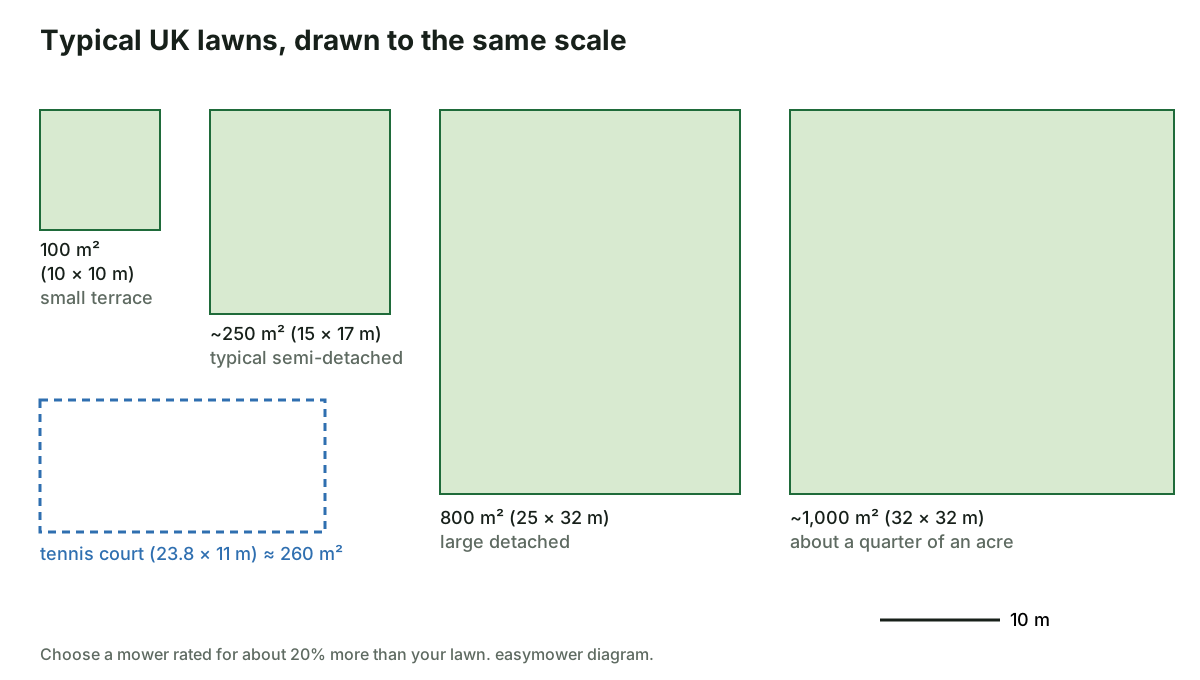
Most people guess their lawn size badly, usually too high. Our lawn size tool lets you draw around your lawn on a satellite map and gives the area in square metres. Only count the grass: patios, beds and paths don't need mowing, although the mower may need to cross some of them.
Once you have a figure, add a margin. We suggest choosing a model rated for at least 20% more than your lawn, for three reasons.
- Manufacturers quote best-case figures, and they calculate them differently. Husqvarna gives its working area as plus or minus 20% and lists a lower figure for random (rather than systematic) mowing. Kress titles its wired models with a 72-hour "maximum" area and its network RTK models with a 48-hour "recommended" area. Honda's and STIGA's manuals give recommended areas below the numbers on their product pages. A mower that's just big enough on paper may be flat out in May.
- Complicated lawns take longer. Every island bed, tree and narrow strip adds turning and travelling time. A long, thin lawn or one split into several zones behaves like a bigger lawn.
- Grass grows fastest when the weather is worst for mowing. In a wet UK spring, a mower may lose whole days to rain. Spare capacity lets it catch up.
Don't go too far the other way. A mower rated for five times your lawn costs more, is usually heavier and wider, and may struggle to squeeze through the gaps a small garden has. As a rough guide:
- Under about 400 m²: small, light models are easier to live with. Many are wired, and a few cheaper camera-only models exist.
- About 400–1,500 m²: the most competitive part of the market, with dozens of wired and wire-free options.
- Over about 1,500 m²: wide cuts, bigger batteries and good navigation over open ground start to matter. See the table below.
| Model | Price from | Max lawn | Navigation | Max slope | Score |
|---|---|---|---|---|---|
| Honda Miimo HRM 1000 to 4000 | £474 | 4,000 m² | Perimeter wire | 47% | 6.7 |
| Kress Mission RTKn | £674.50 | 5,000 m² | Network RTK | 40% | 7.4 |
| Kress EyePilot RTKn | £1,069 | 10,000 m² | Hybrid (RTK + vision/LiDAR) | 40% | 8.2 |
| Ambrogio Twenty | £1,249 | 3,500 m² | Perimeter wire | 45% | 6.4 |
| Segway Navimow H2 Series | £1,499 | 3,000 m² | Hybrid (RTK + vision/LiDAR) | 45% | 8.3 |
| Worx Landroid Vision Cloud 4WD | £1,649.99 | 4,000 m² | Hybrid (RTK + vision/LiDAR) | 84% | 8.0 |
| MammotionMammotion LUBA 2 AWD | £1,699 | 10,000 m² | Hybrid (RTK + vision/LiDAR) | 80% | 8.8 |
| Kress EyePilot 4×4 RTKn | £1,749 | 10,000 m² | Hybrid (RTK + vision/LiDAR) | 84% | 8.4 |
| Kress Mission Mega | £1,749RRP | 6,500 m² | Perimeter wire | 45% | 7.0 |
| Sunseeker X7 | £1,949 | 6,000 m² | Hybrid (RTK + vision/LiDAR) | 70% | 8.1 |
How robot mowers find their way
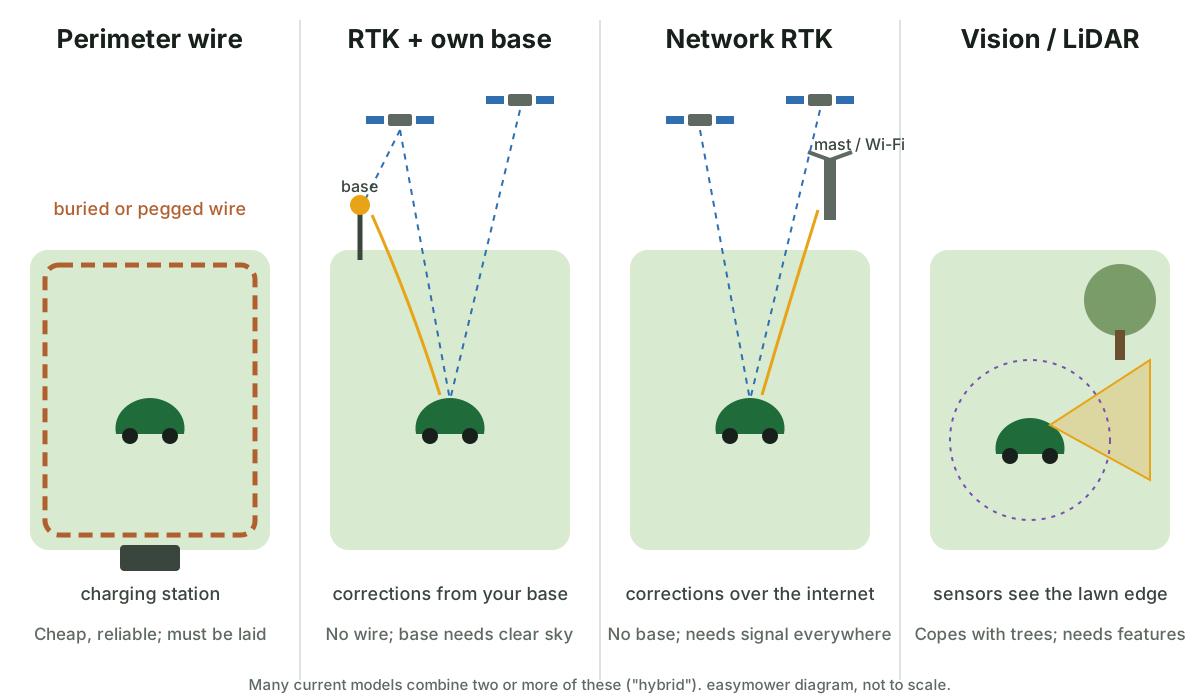
Navigation is the biggest decision you'll make, because it decides how you install the mower, what can go wrong and how much it costs. There are five approaches on sale in the UK today.
Perimeter wire
The traditional method. You lay a thin wire around the edge of the lawn and around anything you want the mower to avoid, such as beds and ponds. The mower detects the wire's signal and stays inside it. Most wired mowers cut in a semi-random pattern, crossing the lawn at different angles and relying on frequent mowing to give an even finish.
Wire is cheap, mature and completely indifferent to trees, buildings, mobile signal and satellites. That's why it's still the default for small and shaded gardens. The downsides are the installation work, the risk of cutting the wire when you edge or dig, and the effort of moving it when you change a bed. Our wired robot mower hub covers these in detail.
RTK with your own base station
RTK (real-time kinematic) positioning uses satellite navigation, but corrects it with a second, fixed receiver so the mower knows where it is to within a few centimetres. With this type you mount a small base station, usually on a pole or wall, somewhere with a clear view of the sky. You then draw the lawn's boundary in an app, usually by driving the mower around the edge.
It works well on open lawns and lets the mower cut in neat straight lines. It struggles where the sky is blocked: under dense trees, close to a tall house, or in a narrow gap between buildings. That's a real limitation in many UK gardens, which tend to be small, overlooked and planted. Examples include the STIGA A-series and the Ecovacs GOAT O RTK.
Network RTK over 4G
Network RTK does the same job without a base station in your garden. The mower receives its corrections over a mobile data connection from a network of reference stations run by the manufacturer or a partner. There's nothing to mount, which makes installation easier and tidier.
The trade-off is that it needs mobile coverage across the lawn as well as a clear sky. Rural and hilly parts of the UK still have gaps, and signal at the bottom of a garden can be worse than at the house. Most brands have a postcode checker, and Ofcom's mobile coverage checker shows which networks reach your address. Husqvarna's smaller wire-free models use Wi-Fi rather than 4G for their corrections, so they need your home Wi-Fi to reach the whole lawn. Examples of network RTK include the STIGA A v range, the Kress Mission RTKn and the Segway Navimow i2 AWD.
Vision (cameras)
Camera-only mowers recognise grass, edges and obstacles visually. Some map the lawn and cut in lines; the simplest ones just follow the edge of the grass and mow at random. They need no satellites, no signal and often no installation beyond placing the charging station.
They depend on clear, well-defined lawn edges and reasonable light. Bosch, for example, says its Bosch VISIMOW18V mows only in daylight and needs physical borders or non-grass strips to recognise where the lawn ends. Vision works well on small, simple lawns with obvious boundaries and less well where grass runs into meadow, gravel or a neighbour's lawn with nothing in between.
LiDAR
LiDAR mowers scan their surroundings with a laser and build a 3D map from fixed features such as walls, fences, sheds, trees and the house. They then locate themselves against that map. No satellites and no base station are needed, which makes LiDAR a natural fit for UK gardens that are close to buildings and full of trees.
The weakness is the opposite of RTK's: LiDAR needs things to see. In a large, open lawn with the nearest wall a long way off, it has less to work with. Examples include the Segway Navimow i2 LiDAR, the Dreame A1 Pro and the Ecovacs GOAT O1200 LiDAR PRO.
Hybrid
A growing number of mowers combine two or three of these methods: network RTK for open areas, and LiDAR or cameras for shaded spots and obstacle detection. On paper this gives the fewest dead spots, and it's where most premium development is happening. Examples include the Mammotion LUBA 3 AWD, the Segway Navimow X4 and Husqvarna's Husqvarna Automower 430V NERA.
Be careful with the word "hybrid" on spec sheets, though. It covers everything from a camera that only avoids obstacles to full fusion of three positioning systems. Our model pages say exactly which sensors each version uses, and the versions within one range can differ: the Mammotion LUBA mini 2 AWD 1000 uses cameras with network RTK, while the 1500 uses LiDAR and cameras with no RTK at all.
Matching navigation to a UK garden
A quick way to narrow it down:
- Open lawn, few tall trees, good mobile signal: network RTK or RTK with a base station works well and is often the best value per square metre.
- Lawn surrounded by buildings, walls and mature trees: LiDAR or a hybrid with LiDAR is the safer choice. Pure RTK may lose its fix in the shadiest corners.
- Rural, with weak mobile signal: avoid anything that depends on 4G for positioning. Look at LiDAR, RTK with your own base, or wire.
- Small, simple lawn with clear edges: a camera-only or wired mower is usually enough, and cheaper.
- Heavy shade throughout: wire remains the most dependable option.
For a deeper explanation, see our guides to RTK, vision and LiDAR and to network RTK and 4G, and our wire-free robot mower hub.
Slopes
Manufacturers quote slope as a percentage, not in degrees, and the two are easy to confuse. A 100% slope rises one metre for every metre forward, which is 45 degrees. So a 35% rating is about 19 degrees, 45% is about 24 degrees and 80% is about 39 degrees.
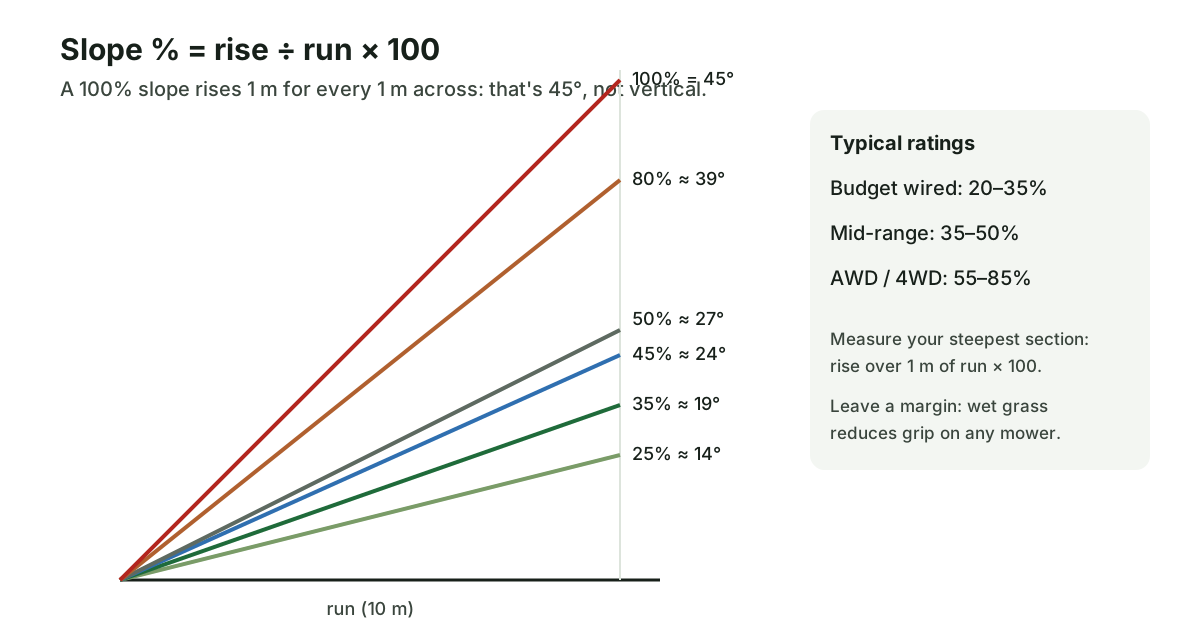
Most two-wheel-drive mowers are rated somewhere between 25% and 50%. All-wheel-drive and four-wheel-drive models go much further: the Mammotion LUBA mini 2 AWD and Mammotion LUBA 3 AWD are rated for 80%, and the Segway Navimow X4, Worx Landroid Vision Cloud 4WD and Kress EyePilot 4×4 for 84%.
Three cautions apply to every rating:
- Ratings are best-case figures. Wet grass, loose soil and moss all reduce grip. UK lawns are damp for much of the year, so leave a margin of at least 10 percentage points.
- Edges are often rated lower. Husqvarna, for example, allows much less slope along the boundary than inside the lawn. A steep bank at the very edge may need the boundary moved in.
- Some tests are generous. Navimow says the X4's 84% figure was achieved with the mower under manual remote control rather than mowing on its own.
If you're not sure how steep your garden is, a phone spirit-level app on a straight plank gives a reasonable reading. Our slopes guide goes into more detail.
| Model | Price from | Max lawn | Navigation | Max slope | Score |
|---|---|---|---|---|---|
| Lymow One Plus | £2,799Out of stock | 7,001 m² | Hybrid (RTK + vision/LiDAR) | 100% | 8.1 |
| Kress EyePilot 4×4 RTKn | £1,749 | 10,000 m² | Hybrid (RTK + vision/LiDAR) | 84% | 8.4 |
| Segway Navimow X4 Series | £2,199 | 5,000 m² | Hybrid (RTK + vision/LiDAR) | 84% | 8.8 |
| Worx Landroid Vision Cloud 4WD | £1,649.99 | 4,000 m² | Hybrid (RTK + vision/LiDAR) | 84% | 8.0 |
| MammotionMammotion LUBA 2 AWD | £1,699 | 10,000 m² | Hybrid (RTK + vision/LiDAR) | 80% | 8.8 |
| MammotionMammotion LUBA 3 AWD | £1,999 | 5,000 m² | Hybrid (RTK + vision/LiDAR) | 80% | 8.8 |
| MammotionMammotion LUBA mini 2 AWD | £1,249 | 1,500 m² | Hybrid (RTK + vision/LiDAR) | 80% | 8.0 |
| Husqvarna Automower 435X AWD NERA | £4,769.10 | 5,000 m² | Network RTK | 70% | 7.5 |
| Sunseeker X7 | £1,949 | 6,000 m² | Hybrid (RTK + vision/LiDAR) | 70% | 8.1 |
| Yarbo Lawn Mower | – | 25,000 m² | RTK (own base station) | 70% | 7.3 |
Zones, passages and multiple lawns
Very few UK gardens are a single rectangle. Front and back lawns, side passages, steps, patios and island beds all affect which mower will work.
Passages. If the mower has to travel between lawn areas on its own, check the narrowest point on the route. Wired mowers need space for the wire to run in and out with a gap between; Honda, for example, gives 60 cm wire to wire for its shortcut-wire models. Wire-free mowers vary widely: Mammotion quotes 55 cm for the YUKA mini 2, while Bosch asks for 120 cm for the VISIMOW. RTK mowers can lose accuracy in a narrow gap between two houses even if they physically fit.
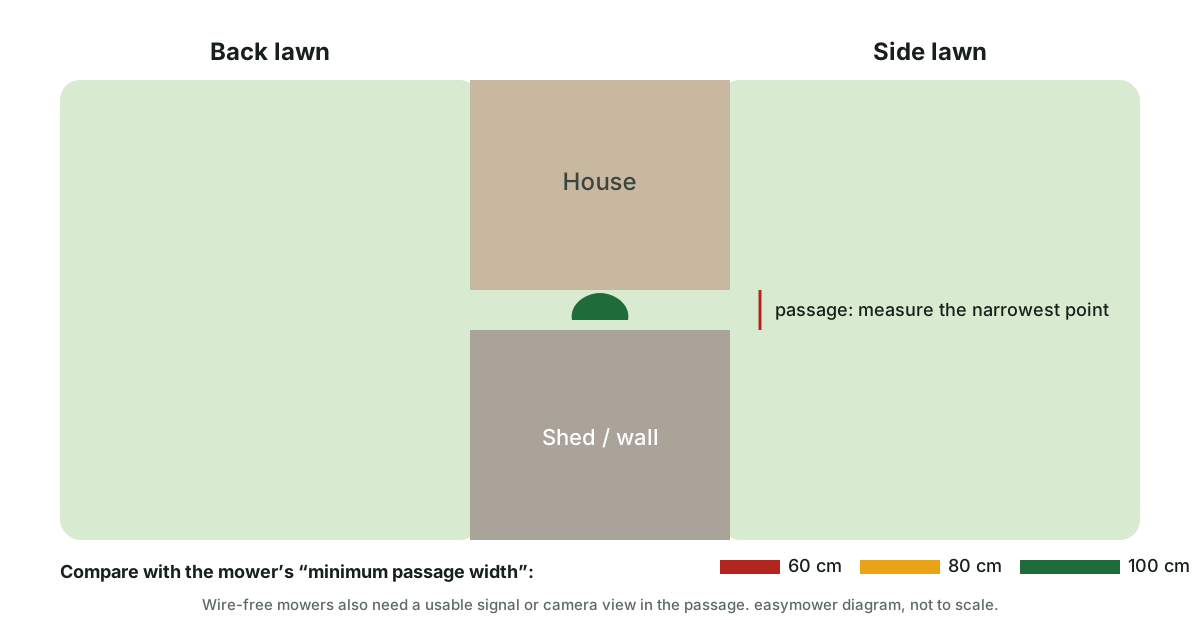
Zones. Wire-free mowers typically let you map several separate zones in the app and link them with virtual paths. The number of zones varies a lot, even within one range: the STIGA A v range manages 10–30 depending on size. More zones means more flexibility, but most gardens need only a handful.
Surfaces and steps. Robot mowers can cross short sections of patio or gravel, but not steps. If the only way from front to back is up a flight of steps, you'll either carry the mower or run two lawns as separate maps. Check the weight on the model page before deciding you'll carry it: the big all-wheel-drive models are heavy.
Our guide to complex gardens covers multi-lawn setups in more detail.
Cut quality
Robot mowers don't collect clippings. They cut a little often, and the fine clippings fall back into the lawn as mulch. Done frequently, that gives a dense, even lawn. The main differences between models are the blades, the cutting pattern and how close they get to the edges.
- Blades. Most use small pivoting razor blades on a spinning disc. They're cheap to replace and fold back on impact. A few use a fixed blade or a mulching disc. Our blade guide explains the types and costs.
- Cut width. Wider cuts cover big lawns in fewer passes. Most mowers cut around 180–250 mm; the Segway Navimow X4 cuts 430 mm and the Mammotion LUBA 3 AWD 400 mm.
- Pattern. Most wire-free mowers cut in straight lines, which gives the striped look and usually finishes a lawn faster. Wired mowers mostly cut at random. Both give a good result if the mower runs often enough.
- Height. Check the range and how you adjust it. App or electric adjustment is easier than a manual dial, and lets you raise the cut for a dry spell or lower it gradually in spring.
- Edges. No robot mower cuts right up to every edge. The cutting disc sits inside the body, so there's usually a strip left along walls, fences and beds. Some models add an offset disc or a built-in trimmer to narrow that strip; the Ecovacs GOAT O1200 LiDAR PRO and Segway Navimow H2 are listed with full edge cutting. Setting the mower's boundary to run over a flush mowing strip or path edge helps with any model.
A robot mower isn't designed to tackle long grass. If your lawn has been left for weeks, cut it down with a conventional mower before the robot takes over.
UK weather: rain, wet grass and winter
UK conditions are harder on robot mowers than their marketing shots suggest. Plan for three things.
Rain. Most robot mowers are built to stay outside, and many have a rain sensor that stops mowing and sends them back to charge. Mowing in the rain doesn't damage a well-sealed mower, but it gives a ragged cut and can leave wheel marks on soft ground. Most apps let you pause mowing when it's wet or delay a set time after rain stops. Check the IP rating on the model page before washing one with a hose.
Wet grass and soft ground. Wet grass reduces grip, so slope ratings effectively fall. Heavy mowers on clay soils can rut the lawn in the same tracks, especially near the charging station. Varying the entry and exit route (many apps can do this) spreads the wear.
Winter. Grass grows slowly below about 5°C, so most owners stop mowing from late autumn to early spring. Manufacturers generally advise cleaning the mower, charging the battery and storing it indoors somewhere dry and frost-free. Some recommend a winter service. Leaving a mower out in freezing weather is often against the manual's advice and can affect the battery. See our winter storage guide.
A garage or cover keeps leaves and direct sun off the mower in summer, but it's not essential for most models. Our guide to robot mower garages explains when it's worth it.
Hedgehogs and wildlife
Hedgehogs are in decline in the UK and are mostly active at night, which is when an unattended mower on a timer may be running. The British Hedgehog Preservation Society advises against mowing at night. The simplest thing you can do is set your schedule to daylight hours only, which every app allows.
Obstacle detection helps, and camera and LiDAR models are better at spotting objects than bump sensors alone. But no manufacturer claims its mower reliably detects a curled-up hedgehog, and we don't recommend relying on it. Our hedgehog guide has more on schedules and safe gardens.
Security and theft
A robot mower sits in the garden unattended, which makes it an obvious target. Almost all have a PIN code and an alarm that sounds if the mower is lifted. The meaningful difference is what happens next.
- PIN and alarm: standard on almost everything. It makes a stolen mower less useful but doesn't help you get it back.
- App lock: many wire-free mowers are tied to the owner's account and can't be used by anyone else.
- GPS tracking with 4G: the mower reports its location after it leaves the garden. This needs a mobile connection, either built in or as an add-on module, and usually a data plan after the included period.
Positioning a mower out of sight of the street, fitting a garage that locks, and registering it with the manufacturer all help. Check your home insurance too; not all policies cover garden equipment left outside. Our theft and security guide has the details.
Apps, 4G and subscriptions
Almost every current robot mower has an app. What differs is how much it can do and how it connects.
- Bluetooth only: you can control the mower when you're nearby. Fine for simple wired models.
- Wi-Fi: control from anywhere, as long as your router reaches the mower. Many gardens need a Wi-Fi extender.
- 4G: control, alerts and tracking from anywhere with no dependence on home Wi-Fi. Network RTK models use it for positioning too.
4G data is usually included for a period and then renewed for a fee. The included period varies a great deal: Mammotion includes 36 months of data with the LUBA mini 2 AWD, Navimow 12 months with the i2 range, and STIGA ten years (120 months) with its A v range.
For most models, renewal pays for remote features, not basic mowing. There are exceptions. STIGA says its robots won't start mowing without their cloud connection, and its first-generation A 4 and A 8 need a paid pack after the included period. Always check whether a mower keeps mowing if you stop paying; our model pages record what each manufacturer says.
Running costs
The purchase price is most of what you'll spend, but not all of it.
- Electricity: small. A robot mower battery holds far less energy than a typical household appliance uses in a day; the Mammotion LUBA 3 AWD, for example, has a 203 Wh–324 Wh battery. Multiply by the number of charges and by your tariff (see Ofgem's price cap page) for a rough yearly figure.
- Blades: the main consumable. Pivoting razor blades are cheap and usually replaced every one to three months in the growing season.
- 4G renewals: optional on most models, as above.
- Servicing: some brands, including STIGA and Ambrogio, tie extended warranties to annual dealer servicing, which costs money each year.
- Batteries: lithium batteries wear out over several years. Check the battery warranty, which is sometimes shorter than the mower's.
- Repairs to the wire: for wired models, a repair kit is cheap, but finding a break can take time.
Our running-costs calculator puts these together for any model, and our guide to what robot mowers cost explains the ranges.
Warranty and support
Warranty terms vary more than most buyers realise. Honda offers 5 years on its Miimo range, as long as the mower is registered and serviced by a Honda dealer. Mammotion, Navimow and Ecovacs offer three years on their current mowers. Husqvarna, Worx and many others offer two years as standard, sometimes extended if you register or service the mower with a dealer.
Where you buy matters too. Some brands sell direct online, others only through dealers who install and service the mower. A dealer-installed mower costs more but comes with local support, which is worth something if a wired installation goes wrong or a mower needs repairing in the middle of the season. Each brand page on easymower lists the UK warranty terms and how the brand sells.
Installation
How much work installation takes depends almost entirely on the navigation type.
Wired mowers. You lay a boundary wire around the lawn and around beds, ponds and trees you want avoided, then connect it to the charging station. The wire can be pegged on the surface, where the grass grows over it within a few weeks, or buried a few centimetres down with a spade or a hired cable layer. A typical lawn takes an afternoon to a day. Dealers will do it for a fee, and some brands include it. Get the details right: wire spacing at corners, the distance from hard edges, and the shortcut or guide wire all affect how well the mower works.
RTK with a base station. Mount the base station on a pole or wall with a clear view of the sky, within range of the mower and, usually, near a power supply. Then map the lawn in the app by driving the mower around the edge.
Network RTK, LiDAR and vision. Place the charging station, connect the mower to the app and map the lawn. Some models map themselves automatically; others need you to drive the boundary with your phone. This can be done in an hour or two, and changes later take minutes.
Whatever the type, the charging station needs a mains socket within reach of its cable, and ideally a level spot at the edge of the lawn. Our installation guide walks through both wired and wire-free setups.
Which type of mower suits which garden
Putting it all together, here's where we'd start for some common UK gardens. These are starting points for a shortlist, not a substitute for checking the details on each model page.
A small, flat back garden (under about 400 m²), with walls or fences. A wired mower such as the Worx Landroid M or GARDENA SILENO city is simple and cheap. If you'd rather avoid the wire, a small LiDAR or camera model such as the TerraMow Mini 500 or eufy C15 is worth a look.
A medium suburban lawn (about 400–1,500 m²) with trees and a house close by. This is where LiDAR and hybrid models make the most sense. The Segway Navimow i2 LiDAR and Mammotion LUBA mini 2 AWD 1500 don't depend on satellite signal. If budget is tight, a proven wired model such as the Husqvarna Automower 310 Mark II avoids signal questions altogether.
A medium, open lawn with good mobile signal. Network RTK is efficient here. The Segway Navimow i2 AWD, STIGA A v range and Kress Mission RTKn all avoid a base station.
A sloping garden. Look at all-wheel-drive and four-wheel-drive models: the Mammotion LUBA mini 2 AWD for medium lawns, or the Worx Landroid Vision Cloud 4WD and Kress EyePilot 4×4 for bigger ones.
A large lawn (over about 2,000 m²). Width of cut and battery capacity matter as much as navigation. The Segway Navimow X4, Mammotion LUBA 3 AWD, STIGA A v range (A 50v to A 140v) and Husqvarna's Husqvarna Automower 450V NERA are all built for this. If you already have a wire or prefer one, the Kress Mission Mega and Honda Miimo HRM cover big lawns for less.
A tight budget. Wired mowers are the cheapest route in, and there's a good choice under £1,000. The table below shows the cheapest current wire-free options if you want to skip the wire.
| Model | Price from | Max lawn | Navigation | Max slope | Score |
|---|---|---|---|---|---|
| LawnMaster OcuMow 16 | £229.99 | 300 m² | Vision (camera) | 35% | 5.9 |
| Bosch VISIMOW18V | £299.98 | 200 m² | Vision (camera) | 35% | 5.7 |
| LawnMaster OcuMow AMB16 | £379.99 | 600 m² | Vision (camera) | 35% | 6.8 |
| Ecovacs GOAT O RTK (O600 RTK / O800 RTK) | £449 | 800 m² | RTK (own base station) | 45% | 7.5 |
| LawnMaster OcuMow 18 | £499.99 | 800 m² | Vision (camera) | 35% | 6.9 |
| Einhell FREELEXO CAM | £579.95 | 500 m² | Vision (camera) | 25% | 6.4 |
| Worx Landroid Vision Cloud | £599.99 | 1,800 m² | Hybrid (RTK + vision/LiDAR) | 30% | 7.7 |
| TerraMow Mini 500 | £656Out of stock | 500 m² | Vision (camera) | 32.5% | 6.7 |
For more focused shortlists, see our best-of guides for large gardens, small gardens, slopes, complex gardens, budget mowers and mowers under £1,000. If you'd rather answer a few questions, our mower finder filters the whole catalogue for your garden.
How we chose our picks
We haven't tested any of these mowers yet, and none of the picks above is based on hands-on use. They're desk-based judgements, made in the same way for every brand:
- We started from every mower currently sold in the UK, using our catalogue of manufacturer specifications. Each value links back to its source, and we note where a manufacturer's pages disagree with its own manuals.
- We ruled out models that aren't current in the UK or that have no UK price, either an RRP or a price from the manufacturer's own store. Models on clearance can still be good buys, but we don't build picks around stock that may vanish.
- We compared value by rated area and features, not headline price alone: navigation type, slope rating, cut width, 4G, and what happens when included data runs out.
- We weighted UK conditions. Trees, buildings and patchy mobile signal count against pure RTK in many gardens, and a long warranty counts for more when parts and service are provided by a small UK operation.
- We named the trade-offs. Every pick says who it isn't for.
Our overall scores use the same rubric across the whole catalogue. Navigation and value are calculated from the data, and cut quality, setup, app and support are editorial judgements from documentation. The weights and method are published on our how we score page. Prices update automatically from UK retailers; see how we get prices. When we do test mowers, we'll mark those pages clearly and explain what changed.
Frequently asked questions
What is the best robot lawn mower in the UK?
For most UK gardens we'd shortlist the Mammotion LUBA mini 2 AWD: it needs no wire or base station, handles steep slopes and comes with a three-year warranty. It's a desk-based judgement from specifications; we haven't tested it. Large lawns need something bigger, such as the Segway Navimow X4, and small flat lawns can be served well by a cheaper wired mower.
Are wire-free robot mowers better than wired ones?
They're easier to install and change, and most add better apps and theft tracking. Wired mowers are cheaper and don't depend on satellite or mobile signal, so they remain a sound choice for small, simple or heavily shaded lawns. The right answer depends on your garden rather than the technology.
What size robot mower do I need?
Measure your lawn (our lawn size tool does it on a map) and choose a model rated for at least 20% more. Manufacturers quote best-case figures, and several publish a lower recommended area in their manuals. Add more margin for lots of obstacles, narrow sections or steep ground.
Do robot mowers work under trees?
It depends on how they navigate. RTK mowers need a clear view of the sky and can lose accuracy under dense canopy or close to tall buildings. LiDAR and vision mowers don't need satellites and usually cope better, and wired mowers aren't affected at all. Hybrid mowers combine methods to cover each other's weak spots.
Can robot mowers handle slopes?
Most are rated between 25% and 50%, and all-wheel-drive models go much higher, up to 80% or more. A 100% slope is 45 degrees, so 50% is about 27 degrees. Ratings are best-case figures; wet grass reduces grip, so leave a margin.
Do robot lawn mowers need a subscription?
Most don't need one to mow. Many wire-free models include a period of 4G data and then charge for renewals, which pay for remote control and theft tracking rather than basic mowing. A few models do need a paid connection to keep working after the included period, so check the model page.
Can a robot mower be left out in the rain?
Most are designed to live outside and many have a rain sensor that sends them back to charge. Mowing wet grass gives a poorer cut and can mark soft lawns, so it's worth setting the mower to pause in rain. Check the IP rating on the model page before hosing one down.
Are robot mowers safe for hedgehogs?
No robot mower can guarantee it. Hedgehogs are mainly active at night, so the simplest protection is to schedule mowing in daylight only. Camera and LiDAR obstacle detection helps, but small animals are hard for any sensor to spot.
How much does a robot lawn mower cost to run?
Electricity is a small part of it. The bigger running costs are replacement blades, optional 4G data after the included period and, for some brands, dealer servicing to keep an extended warranty valid. Our running-costs calculator gives a yearly estimate for each model.
Have you tested these robot mowers?
Not yet. Every recommendation on easymower is based on manufacturer specifications, manuals, UK warranty terms and prices, and we mark pages clearly as not tested. Our scoring method is published on our how-we-score page.
Brands
Robot mowers by brand
Every brand with a robot mower on sale in the UK, and how many current models each sells.

Mower finder
Not sure which mower fits your garden?
Tell us your lawn size, slopes, trees and budget. The finder filters every current model down to the ones that fit, and explains why.
Measure your lawn on a mapHow we pick and score: our methodology. Last updated 2026-09-29.