No boundary wire
Wire-free robot lawn mowers
A wire-free robot mower lets you skip the boundary wire and draw the lawn in an app instead. The catch is that each way of navigating without a wire has its own weak spots, and UK gardens, with their trees, walls and patchy mobile signal, find them quickly. This page explains the options and lists every current wire-free model with live UK prices.

Our picks
The best wire-free robot mowers
Why each one made the list, and the trade-off to know about before you buy.
Best wire-free all-rounder
Mammotion LUBA mini 2 AWD
- Up to 1,500 m²
- Hybrid (RTK + vision/LiDAR)
- 80% slopes
Combines cameras with network RTK (1000) or LiDAR (1500), so there's no base station either way. All-wheel drive, an 80% slope rating, three years of 4G data and a three-year warranty.
Trade-off The two sizes use different navigation, so choose by garden layout. Rated for no more than 1,500 m².
Best for trees and buildings
Segway Navimow i2 LiDAR
- Up to 2,000 m²
- LiDAR
- 45% slopes
Navigates by LiDAR and a camera, with no dependence on satellite or mobile signal for positioning, so shaded lawns next to houses suit it. Rated for up to 2,000 m² with a 220 mm cut and a three-year warranty.
Trade-off Two-wheel drive with a 45% slope limit, and wide open lawns with little around them give LiDAR less to work with.
Best network RTK
STIGA A v range (A 6v to A 25v)
- Up to 2,500 m²
- Network RTK
- 45% slopes
Network RTK over 4G with no aerial in the garden, an AI camera for obstacles, a rain sensor, GPS tracking and ten years of connectivity included, which is far longer than most rivals.
Trade-off STIGA says the robot won't mow without its cloud connection, and a paid plan is needed after the included period. Pure RTK positioning can struggle under dense trees.
Best cheap wire-free
Segway Navimow i2 AWD
- Up to 1,000 m²
- Network RTK
- 45% slopes
One of the least expensive ways to get network RTK, a driven third wheel and a three-year warranty, in sizes from 500 m² to 1,000 m².
Trade-off Needs mobile coverage and a clear sky across the lawn, only one year of 4G data is included, and every version was sold out on Navimow's UK store at the end of the 2026 season.
Best for large wire-free lawns
Segway Navimow X4 Series
- Up to 5,000 m²
- Hybrid (RTK + vision/LiDAR)
- 84% slopes
Rated for up to 5,000 m² with a 430 mm cut, four-wheel drive and a fusion of RTK, cameras and time-of-flight sensing that doesn't need a base station.
Trade-off Expensive, sold through dealers and retailers only, and Navimow's 84% slope figure was achieved under manual remote control.
Live prices
Every wire-free robot mower
Live prices from UK retailers where we have them, otherwise the manufacturer’s RRP.
| Model | Price from | Max lawn | Navigation | Max slope | Score |
|---|---|---|---|---|---|
 Anthbot Genie Anthbot Genie | – | 3,600 m² | Hybrid (RTK + vision/LiDAR) | 45% | 7.9 |
| Anthbot M5 | – | 500 m² | Hybrid (RTK + vision/LiDAR) | 45% | 7.9 |
| Anthbot M9 | – | 1,000 m² | Hybrid (RTK + vision/LiDAR) | 45% | 7.9 |
 Bosch VISIMOW18V Bosch VISIMOW18V | £299.98 | 200 m² | Vision (camera) | 35% | 5.7 |
 Dreame A1 Pro Dreame A1 Pro | £699 | 2,000 m² | LiDAR | 45% | 8.1 |
 Ecovacs GOAT O RTK (O600 RTK / O800 RTK) Ecovacs GOAT O RTK (O600 RTK / O800 RTK) | £449 | 800 m² | RTK (own base station) | 45% | 7.5 |
| Ecovacs GOAT O1200 LiDAR PRO | £949 | 1,200 m² | LiDAR | 45% | 7.9 |
| Ecovacs GOAT O500 Panorama | £799Out of stock | 500 m² | Hybrid (RTK + vision/LiDAR) | 45% | 7.4 |
 Einhell FREELEXO CAM Einhell FREELEXO CAM | £579.95 | 500 m² | Vision (camera) | 25% | 6.4 |
 GARDENA smart SILENO free GARDENA smart SILENO free | £1,299 | 1,200 m² | Network RTK | 35% | 7.4 |
| GARDENA smart SILENO sense | £999 | 600 m² | Hybrid (RTK + vision/LiDAR) | 25% | 7.9 |
 Honda Miimo 1500i and 2200i Honda Miimo 1500i and 2200i | £2,075RRP | 2,200 m² | Network RTK | 47% | 6.7 |
 Husqvarna Automower 305E NERA Husqvarna Automower 305E NERA | £1,549 | 900 m² | Network RTK | 30% | 6.4 |
| Husqvarna Automower 308V | £1,249 | 800 m² | Hybrid (RTK + vision/LiDAR) | 40% | 7.1 |
| Husqvarna Automower 310E NERA | £1,949 | 1,500 m² | Network RTK | 30% | 6.7 |
| Husqvarna Automower 312V | £1,499 | 1,200 m² | Hybrid (RTK + vision/LiDAR) | 40% | 7.2 |
| Husqvarna Automower 320 NERA | £2,499 | 3,300 m² | Network RTK | 50% | 7.2 |
| Husqvarna Automower 405VE NERA | £2,299 | 900 m² | Hybrid (RTK + vision/LiDAR) | 30% | 7.4 |
| Husqvarna Automower 410VE NERA | £2,849 | 1,500 m² | Hybrid (RTK + vision/LiDAR) | 30% | 7.6 |
| Husqvarna Automower 430V NERA | £3,799 | 4,800 m² | Hybrid (RTK + vision/LiDAR) | 50% | 8.0 |
| Husqvarna Automower 430X NERA | £3,299 | 4,800 m² | Network RTK | 50% | 7.6 |
| Husqvarna Automower 435X AWD NERA | £4,769.10 | 5,000 m² | Network RTK | 70% | 7.5 |
| Husqvarna Automower 450V NERA | £4,898 | 7,500 m² | Hybrid (RTK + vision/LiDAR) | 50% | 8.3 |
| Husqvarna Automower 450X NERA | £3,599.20 | 7,500 m² | Network RTK | 50% | 7.8 |
| Husqvarna Automower Aspire R6V | £999 | 600 m² | Hybrid (RTK + vision/LiDAR) | 40% | 7.1 |
 Kress EyePilot 4×4 RTKn Kress EyePilot 4×4 RTKn | £1,749 | 10,000 m² | Hybrid (RTK + vision/LiDAR) | 84% | 8.4 |
| Kress EyePilot RTKn | £1,069 | 10,000 m² | Hybrid (RTK + vision/LiDAR) | 40% | 8.2 |
| Kress Mission RTKn | £674.50 | 5,000 m² | Network RTK | 40% | 7.4 |
 LawnMaster OcuMow 16 LawnMaster OcuMow 16 | £229.99 | 300 m² | Vision (camera) | 35% | 5.9 |
| LawnMaster OcuMow 18 | £499.99 | 800 m² | Vision (camera) | 35% | 6.9 |
| LawnMaster OcuMow AMB16 | £379.99 | 600 m² | Vision (camera) | 35% | 6.8 |
 Lymow One Plus Lymow One Plus | £2,799Out of stock | 7,001 m² | Hybrid (RTK + vision/LiDAR) | 100% | 8.1 |
 MammotionMammotion LUBA 2 AWD MammotionMammotion LUBA 2 AWD | £1,699 | 10,000 m² | Hybrid (RTK + vision/LiDAR) | 80% | 8.8 |
| MammotionMammotion LUBA 3 AWD | £1,999 | 5,000 m² | Hybrid (RTK + vision/LiDAR) | 80% | 8.8 |
| MammotionMammotion LUBA mini 2 AWD | £1,249 | 1,500 m² | Hybrid (RTK + vision/LiDAR) | 80% | 8.0 |
| MammotionMammotion YUKA mini 2 | £799 | 1,000 m² | Hybrid (RTK + vision/LiDAR) | 45% | 7.8 |
 Segway Navimow H2 Series Segway Navimow H2 Series | £1,499 | 3,000 m² | Hybrid (RTK + vision/LiDAR) | 45% | 8.3 |
| Segway Navimow X4 Series | £2,199 | 5,000 m² | Hybrid (RTK + vision/LiDAR) | 84% | 8.8 |
| Segway Navimow i Series (i1) | £699 | 800 m² | Hybrid (RTK + vision/LiDAR) | 30% | 7.2 |
| Segway Navimow i2 AWD | £799 | 1,000 m² | Network RTK | 45% | 7.3 |
| Segway Navimow i2 LiDAR | £999 | 2,000 m² | LiDAR | 45% | 8.2 |
| Segway Navimow i2 LiDAR Pro | £1,199 | 2,000 m² | Hybrid (RTK + vision/LiDAR) | 55% | 8.1 |
 STIGA A v range (A 6v to A 25v) STIGA A v range (A 6v to A 25v) | £999 | 2,500 m² | Network RTK | 45% | 7.7 |
| STIGA A v range large (A 50v to A 140v) | £2,999 | 14,000 m² | Network RTK | 50% | 8.5 |
| STIGA A-series (A 4 to A 1500) | £899 | 2,500 m² | RTK (own base station) | 45% | 7.2 |
| STIGA A-series large (A 5000 and A 10000) | £3,199 | 12,000 m² | RTK (own base station) | 50% | 8.2 |
 Sunseeker X3 Sunseeker X3 | £949 | 800 m² | Hybrid (RTK + vision/LiDAR) | 30% | 7.7 |
| Sunseeker X5 | £1,699 | 2,000 m² | Hybrid (RTK + vision/LiDAR) | 60% | 7.8 |
| Sunseeker X7 | £1,949 | 6,000 m² | Hybrid (RTK + vision/LiDAR) | 70% | 8.1 |
 TerraMow Mini 500 TerraMow Mini 500 | £656Out of stock | 500 m² | Vision (camera) | 32.5% | 6.7 |
| TerraMow V Series (V600 / V1000) | £899Out of stock | 1,200 m² | Vision (camera) | 32.5% | 7.5 |
 Worx Landroid Vision Cloud Worx Landroid Vision Cloud | £599.99 | 1,800 m² | Hybrid (RTK + vision/LiDAR) | 30% | 7.7 |
| Worx Landroid Vision Cloud 4WD | £1,649.99 | 4,000 m² | Hybrid (RTK + vision/LiDAR) | 84% | 8.0 |
 Yarbo Lawn Mower Yarbo Lawn Mower | – | 25,000 m² | RTK (own base station) | 70% | 7.3 |
| Yarbo Lawn Mower Pro | – | 28,328 m² | RTK (own base station) | 70% | 7.3 |
 eufy C15 Robot Lawn Mower eufy C15 Robot Lawn Mower | £999 | 500 m² | Vision (camera) | 32.5% | 6.7 |
| eufy Robot Lawn Mower E15 | £1,159 | 800 m² | Vision (camera) | 32.5% | 7.0 |
Why go wire-free
Laying a boundary wire is the least-loved part of owning a traditional robot mower. It takes an afternoon to a day, it needs care at corners and around obstacles, and it's easy to cut the next time you edge the lawn or dig a bed. Change the shape of a border and you move the wire too.
Wire-free mowers do away with that. You map the lawn in an app, set up no-go areas for beds and ponds, and edit them whenever you like. Most also cut in neat straight lines rather than at random, have better apps, and include 4G with GPS tracking in case the mower is stolen.
Wire-free doesn't mean effortless, though. Every mower still needs to know exactly where it is, and each of the ways it can do that has conditions where it works well and conditions where it doesn't. Choosing the right navigation for your garden matters more than choosing the right brand.
We haven't tested any of these mowers yet. What follows is based on manufacturer specifications, manuals and well-established principles of how each navigation method works.
| Model | Price from | Max lawn | Navigation | Max slope | Score |
|---|---|---|---|---|---|
| LawnMaster OcuMow 16 | £229.99 | 300 m² | Vision (camera) | 35% | 5.9 |
| Bosch VISIMOW18V | £299.98 | 200 m² | Vision (camera) | 35% | 5.7 |
| LawnMaster OcuMow AMB16 | £379.99 | 600 m² | Vision (camera) | 35% | 6.8 |
| Ecovacs GOAT O RTK (O600 RTK / O800 RTK) | £449 | 800 m² | RTK (own base station) | 45% | 7.5 |
| LawnMaster OcuMow 18 | £499.99 | 800 m² | Vision (camera) | 35% | 6.9 |
| Einhell FREELEXO CAM | £579.95 | 500 m² | Vision (camera) | 25% | 6.4 |
| Worx Landroid Vision Cloud | £599.99 | 1,800 m² | Hybrid (RTK + vision/LiDAR) | 30% | 7.7 |
| TerraMow Mini 500 | £656Out of stock | 500 m² | Vision (camera) | 32.5% | 6.7 |
| Kress Mission RTKn | £674.50 | 5,000 m² | Network RTK | 40% | 7.4 |
| Dreame A1 Pro | £699 | 2,000 m² | LiDAR | 45% | 8.1 |
The five ways to navigate without a wire
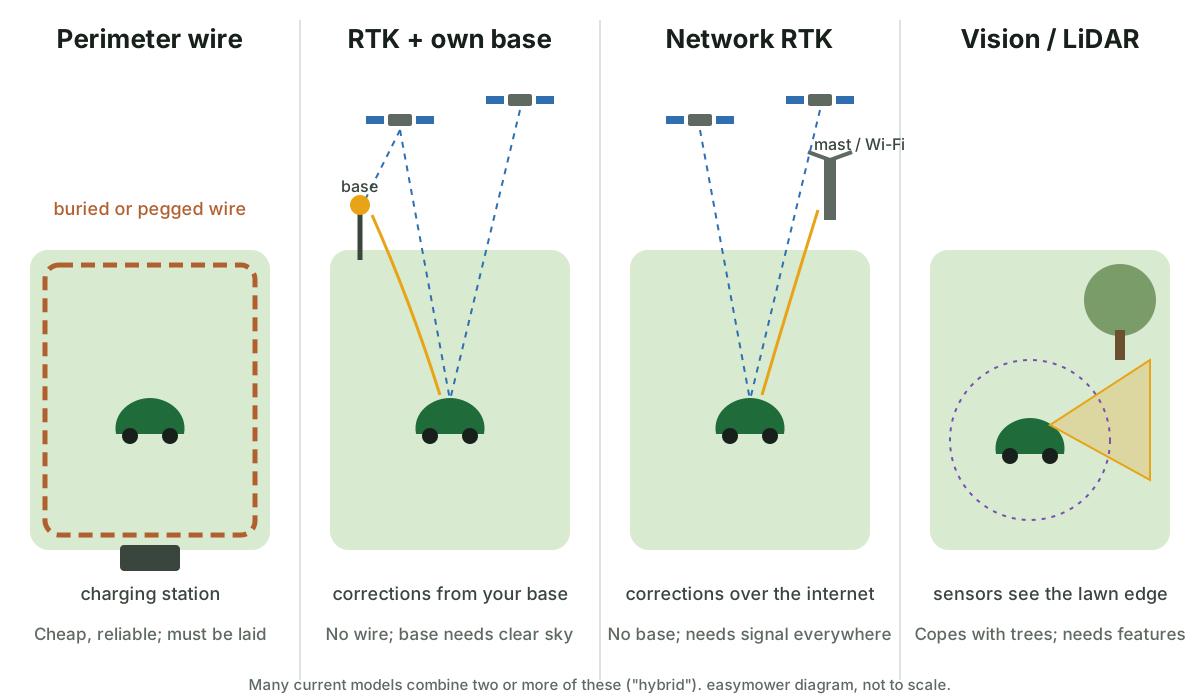
RTK with your own base station
RTK (real-time kinematic) positioning corrects ordinary satellite navigation using a second receiver in a fixed, known position, giving centimetre-level accuracy. With this type, you mount the reference station yourself, usually on a pole or wall with a clear view of the sky and within radio range of the lawn.
Works well: open lawns with few tall obstacles, rural gardens with no mobile signal (because the base talks to the mower directly), and large areas where straight-line mowing saves a lot of time.
Struggles: under dense tree canopy, in the shadow of a tall house, and in narrow gaps between buildings, where the mower can't see enough satellites. You also have one more thing to site and power.
Examples: the STIGA A-series and Ecovacs GOAT O RTK. Some other brands sell a base station as an optional extra for gardens where their network service is weak.
Network RTK over 4G
Network RTK removes the base station. The mower receives its correction data over a mobile connection from a network of reference stations run by the manufacturer or a partner.
Works well: open suburban and rural lawns with good mobile coverage. Installation is the easiest of any type: place the charging station and map the lawn.
Struggles: the same sky-view problem as any RTK under trees and near tall buildings, plus a dependence on mobile signal across the whole lawn. The UK's coverage has improved, but rural valleys, the far end of long gardens and some new-build estates can still be weak. Brands generally offer a postcode checker; Ofcom's mobile coverage checker shows what each network claims for your address.
Two things to check before buying. First, how long the 4G data is included and what renewal costs: Navimow includes 12 months with the i2 AWD, whereas STIGA includes ten years (120 months) with its A v range. Second, whether the mower still mows if you don't renew. STIGA says its robots need their cloud connection to work at all. Navimow says network RTK itself is included at no extra cost, with renewals paying for remote features.
Husqvarna's smaller wire-free models, such as the Husqvarna Automower 308V, receive their corrections over your home Wi-Fi as standard rather than 4G. That removes the mobile question, but your Wi-Fi has to reach the whole lawn.
Examples: the STIGA A v range, Segway Navimow i2 AWD, Kress Mission RTKn and Husqvarna's Husqvarna Automower 310E NERA (wire-free version).
Vision (cameras)
Camera-only mowers recognise grass, edges and obstacles visually. Better models build a map and mow in lines; simpler ones follow the lawn edge and mow at random.
Works well: small to medium lawns with clear edges, such as a lawn bordered by a patio, path, fence or wall. There's nothing to site, no signal to worry about, and nothing to renew.
Struggles: lawns that blend into rough grass, meadow, gravel or a neighbour's lawn with no clear line between them, and poor light. Bosch, for example, says its Bosch VISIMOW18V works only in daylight and needs defined borders or non-grass strips to recognise the edge.
Examples: the eufy E15, TerraMow V series and LawnMaster OcuMow 18.
LiDAR
LiDAR mowers scan their surroundings with a laser and position themselves against fixed features: walls, fences, sheds, tree trunks and the house. No satellites, no base station and no mobile signal are needed for positioning.
Works well: the typical UK suburban garden, surrounded by buildings and fences, with mature trees. These are exactly the conditions that trouble RTK.
Struggles: large, open lawns where the nearest fixed feature is a long way off, and areas where the surroundings change a lot (though most systems cope with seasonal changes like leaves). Manufacturers' passage and range figures are usually measured in ideal conditions.
Examples: the Segway Navimow i2 LiDAR, Dreame A1 Pro and Ecovacs GOAT O1200 LiDAR PRO.
Hybrid
Hybrid mowers combine two or more of the above, typically network RTK for open areas with LiDAR or cameras for shade and obstacles. On paper, it's the most robust approach, and nearly all premium wire-free mowers now use some version of it.
The label covers a lot of ground, though. Some "hybrids" use the camera only to avoid obstacles and still depend on RTK for position. Others genuinely fuse three positioning systems. And versions within one range can differ: Mammotion's Mammotion LUBA mini 2 AWD 1000 pairs cameras with network RTK, while the 1500 uses LiDAR and cameras with no RTK. Our model pages list exactly what each version uses.
Examples: the Mammotion LUBA 3 AWD, Segway Navimow X4, Segway Navimow H2, Worx Landroid Vision Cloud 4WD, Kress EyePilot and Husqvarna's Husqvarna Automower 410VE NERA.
Which navigation suits your garden
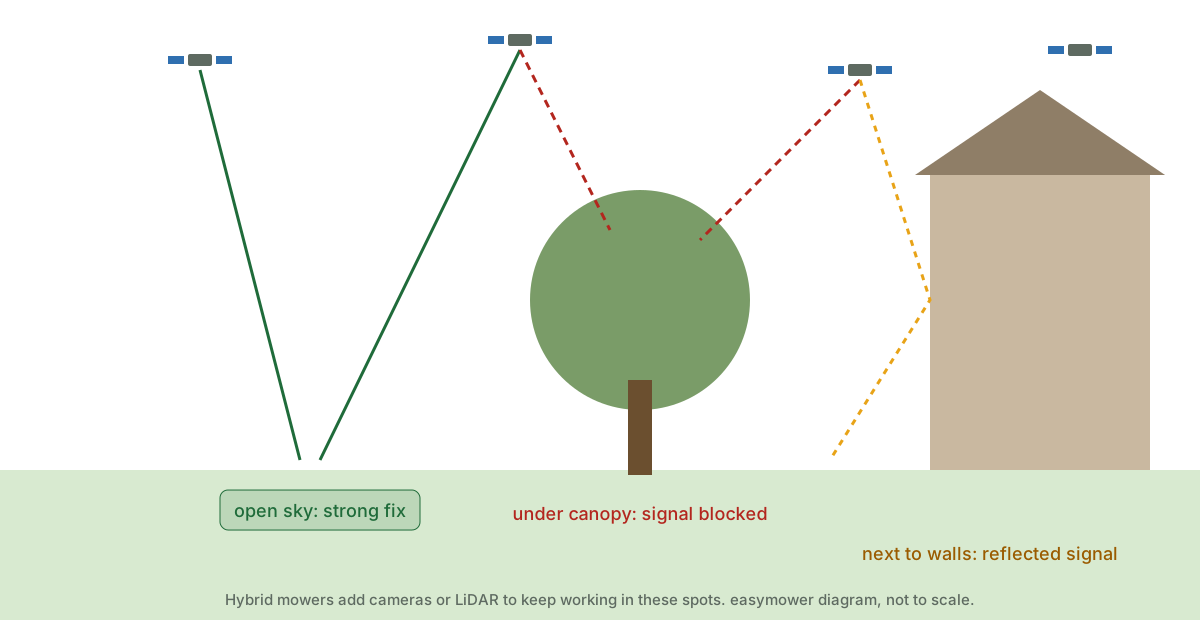
Stand in your garden and look up. Then look around.
- Mostly open sky, good phone signal everywhere on the lawn: network RTK is simple and good value. RTK with your own base works too.
- Open sky, but weak or no phone signal: RTK with your own base station, or LiDAR. Avoid models that depend on 4G for positioning.
- Lawn hemmed in by the house, walls and mature trees: LiDAR or a hybrid that includes LiDAR or vision positioning. Pure RTK may lose its fix in the most shaded corners.
- Small lawn with obvious edges: vision is often enough and usually cheapest.
- A mix of open and shaded areas: hybrid, because it can switch methods as it moves around.
- Very heavy shade throughout, or a garden you don't want to depend on any signal: consider a wired mower. Wire still works everywhere.
Our guides to RTK, vision and LiDAR and to network RTK and 4G in the UK go into more depth, and our perimeter wire vs wire-free guide sets out the wider trade-off.
Slopes, passages and multiple lawns
Wire-free mowers include some of the most capable machines on slopes. All-wheel-drive and four-wheel-drive models such as the Mammotion LUBA mini 2 AWD and Segway Navimow X4 are rated for 80% and 84% respectively. Treat any rating as a best case; wet grass reduces grip. Our slopes guide explains what the percentages mean.
Mapping several lawns is easier without a wire: you draw each zone and link them with a virtual path. Check the narrowest point on each path, and remember that an RTK mower passing down a narrow side return between two houses may lose accuracy even if it physically fits. LiDAR and vision models generally handle side returns better.
| Model | Price from | Max lawn | Navigation | Max slope | Score |
|---|---|---|---|---|---|
| Lymow One Plus | £2,799Out of stock | 7,001 m² | Hybrid (RTK + vision/LiDAR) | 100% | 8.1 |
| Kress EyePilot 4×4 RTKn | £1,749 | 10,000 m² | Hybrid (RTK + vision/LiDAR) | 84% | 8.4 |
| Segway Navimow X4 Series | £2,199 | 5,000 m² | Hybrid (RTK + vision/LiDAR) | 84% | 8.8 |
| Worx Landroid Vision Cloud 4WD | £1,649.99 | 4,000 m² | Hybrid (RTK + vision/LiDAR) | 84% | 8.0 |
| MammotionMammotion LUBA 2 AWD | £1,699 | 10,000 m² | Hybrid (RTK + vision/LiDAR) | 80% | 8.8 |
| MammotionMammotion LUBA 3 AWD | £1,999 | 5,000 m² | Hybrid (RTK + vision/LiDAR) | 80% | 8.8 |
| MammotionMammotion LUBA mini 2 AWD | £1,249 | 1,500 m² | Hybrid (RTK + vision/LiDAR) | 80% | 8.0 |
| Husqvarna Automower 435X AWD NERA | £4,769.10 | 5,000 m² | Network RTK | 70% | 7.5 |
Installation and setup
Setting up a wire-free mower is usually a job of an hour or two:
- Site the charging station on level ground at the edge of the lawn, within reach of a mains socket. For RTK models, a clear view of the sky here helps.
- Mount the base station if your mower uses one: high, with open sky, and within the range the manual gives.
- Connect the mower to the app and update its software.
- Map the lawn by driving the mower around the boundary with your phone, or by letting it map automatically if it can.
- Add no-go areas and paths for beds, ponds, play equipment and routes between lawns.
Take your time over the boundary. Leaving a small margin from walls and drops, and running the edge over a flush path or mowing strip where you can, gives better results than trying to mow right up to every obstacle. Our installation guide covers both wired and wire-free setups.
Security and running costs
Wire-free mowers generally have better theft protection than wired ones. Many are locked to your account and, with 4G, report their location if they leave the garden. Check whether 4G is built in or an add-on, how long data is included, and what the renewal costs; our model pages record what each manufacturer states.
Beyond that, running costs are similar to any robot mower: blades, a little electricity and, for some brands, dealer servicing to keep an extended warranty valid. Our running-costs calculator estimates a yearly figure for each model, and our theft and security guide covers alarms, tracking and insurance.
How we chose these picks
We compared every current wire-free mower sold in the UK on its navigation type and how that suits typical UK gardens, rated area against price, slope rating, 4G and subscription terms, and the length and conditions of the UK warranty. We favoured models that are current and have a published UK price. We haven't tested these mowers, and the picks are desk-based. For the full list across wired and wire-free models, see our guide to the best robot lawn mowers, and for the method behind our scores, see how we score.
Frequently asked questions
How do wire-free robot mowers know where the lawn ends?
You map the boundary in an app, usually by driving the mower around the edge or tracing it on your phone. The mower then works out its position using satellite RTK, cameras, LiDAR or a combination, and stays inside the map. Some camera-only mowers instead recognise where grass meets another surface.
Do wire-free robot mowers work under trees?
It depends on the navigation. RTK needs a clear view of the sky and can lose accuracy under dense canopy. LiDAR and camera-based mowers don't use satellites and generally cope better. Hybrid mowers switch between methods to cover shaded areas.
Do I need 4G for a wire-free mower?
Only for network RTK models, which get their positioning corrections over a mobile connection. Mowers with their own RTK base station, LiDAR or cameras don't need 4G to mow, though many include it for remote control and theft tracking.
Are wire-free mowers worth the extra cost over wired ones?
Often, if your garden suits the navigation type. You save a day of installation, can change the layout in minutes and usually get better apps and theft tracking. For a small, simple or heavily shaded lawn, a wired mower may do the same job for less.
What happens if a wire-free mower loses its signal?
Most pause and wait, return to the charging station or switch to another sensor if they have one. Mowers that rely on a single method, such as RTK alone, are more likely to stop in weak-signal spots than hybrid models.
Mower finder
Not sure which mower fits your garden?
Tell us your lawn size, slopes, trees and budget. The finder filters every current model down to the ones that fit, and explains why.
Measure your lawn on a map