Lawn slope calculator
 Tom
Enter a rise and a length you've measured, or a figure in degrees or percent, and the calculator gives the slope both ways. It then lists the current robot mowers rated for that slope, split into those with room to spare and those right at their limit.
How to use the calculator
Choose how you know the slope, and the answer updates as you type or drag.
- In percent. Drag the slider or type the figure, for example from a site plan. The presets cover common gardens, from a gentle bank to a steep grass bank.
- In degrees. If an app or a builder has given you an angle, enter it here. Robot mower ratings are in percent, so the calculator converts it.
- Measured. Enter the rise and either the level run under a board, or the length along the ground for a whole bank. All in centimetres.
On a phone, you can also press Measure with my phone and lay the phone on the slope. iPhones ask for permission to use motion sensors first. The reading goes into the calculator in degrees.
The picture draws your slope to scale. The dots under it are every current robot mower, placed at its slope rating: the lit ones can climb your lawn. The mowers are listed below, split into those with room to spare and those right at their limit.
How to measure a lawn's slope
You need a straight board or batten, a spirit level and a tape measure.
- Find the steepest part of the lawn. Banks are often steepest near the top or bottom, so check more than one spot.
- Lay the board pointing straight uphill, with the uphill end on the grass.
- Lift the downhill end until the spirit level reads level.
- Measure from the underside of the board's downhill end to the grass. That's the rise. The board's length is the run.
With a 1 m board the rise in centimetres is the slope in percent: a 30 cm gap is a 30% slope. With a longer board, enter both figures and let the calculator divide them.
For a long bank you can't span with a board, measure the length along the ground with a tape and the height difference between top and bottom, and enter those under A whole bank. This gives the average gradient; short steep sections can be much steeper.
Measure across the slope as well as up it. A mower that drives along a bank needs grip sideways too.
Percent and degrees
Slope percentage is rise divided by run, times 100. Degrees are the angle itself. The two don't scale together:
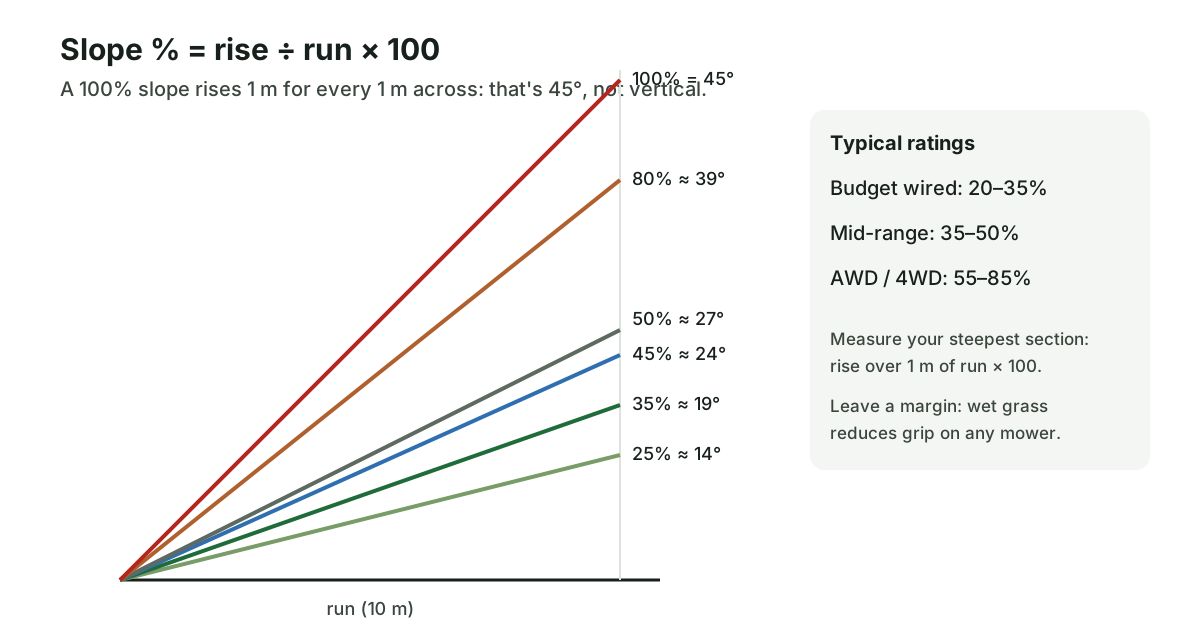
| Percent | Degrees |
|---|---|
| 25% | 14° |
| 35% | 19° |
| 45% | 24° |
| 50% | 27° |
| 70% | 35° |
| 100% | 45° |
Robot mower makers quote ratings in percent. If you've measured in degrees, convert before you compare.
Reading the result
The result gives your slope in both units, then lists every current mower we track that has a published slope rating at least as steep as yours:
- Comfortably within the rating means the mower is rated at least 10 percentage points above your slope.
- At the limit means it's rated for your slope but with less than 10 points to spare. Expect it to struggle on wet grass and soft ground.
Where versions of the same mower have different ratings, the row names the versions it applies to. Mowers without a published slope rating are counted at the bottom of the result but not listed.
What the ratings don't tell you
The ratings are the manufacturers' own figures for the steepest slope the mower can mow inside the lawn, usually on dry, firm grass. Several brands give a much lower figure for slopes at the boundary, because a mower that slips there can leave the lawn. Ratings also don't say much about side slopes, steps or a slope that ends at a drop.
Our guide to robot mowers on slopes covers these in more detail, and best robot mowers for slopes has our picks for steep gardens.
Frequently asked questions
Is a 35% slope the same as 35 degrees?
No. A 35% slope rises 35 cm for every metre across, which is about 19 degrees. A 35 degree slope is about 70%. Robot mower ratings are always given in percent, so a mower rated for 35% can't climb a 35 degree bank.
How do I convert slope percentage to degrees?
Divide the percentage by 100 and take the inverse tangent (tan⁻¹ on a calculator). 45% gives tan⁻¹(0.45), about 24 degrees. To go the other way, take the tangent of the angle and multiply by 100. 100% is 45 degrees, not vertical.
What does a robot mower slope rating of 45% mean?
The mower's maker says it can mow a slope that rises 45 cm per metre, about 24 degrees, inside the lawn. That's a best case on dry, firm grass. Many manufacturers give a lower figure for slopes along the boundary, often 10% to 15%.
How accurate is the phone tilt reading?
Good enough to tell 20% from 40%, but not to the last degree. Phone sensors can be a degree or two out, and bumpy grass adds more. Lay the phone on a straight board rather than straight on the lawn, and take a few readings.
How much margin should I leave below the mower's rating?
We suggest at least 10 percentage points. The calculator lists mowers with that much to spare separately from those right at their limit. Wet grass, soft ground, side slopes and turning on the slope all make a mower more likely to slip.
Next steps
See the mowers built for slopes, and how to set one up on a bank.
- Wire-free robot mowers
- Wired robot mowers
- The cheapest robot mowers worth buying
- The best robot lawn mowers for complex gardens
- The best robot lawn mowers for large gardens
- The best robot lawn mowers for slopes
- The best robot lawn mowers for small gardens
- The best robot lawn mowers under £1,000
- Robot mowers on slopes: what the percentages mean
- Robot mowers for multiple lawns, narrow passages and complex gardens