Guide
Robot mowers on slopes: what the percentages mean
Robot mower slope ratings are given as a percentage: the rise divided by the horizontal distance. A 100% slope is 45 degrees, not vertical, and a 45% rating is about 24 degrees. This guide explains the maths, shows how to measure your own lawn with a spirit level and a tape, and explains why you should leave a margin for wet grass, side slopes and edges.

The short answer
Slope ratings are percentages, not degrees. A slope's percentage is how far it rises divided by how far it runs horizontally, times 100. So a 25% slope rises 25 cm over a metre (about 14 degrees), a 45% slope is about 24 degrees, and a 100% slope is 45 degrees, not a vertical wall.
Most two-wheel-drive robot mowers are rated somewhere between 25% and 50%. All-wheel-drive and four-wheel-drive models go much higher. Whatever the rating, treat it as a best case and leave a margin for wet UK grass.
Percentages and degrees
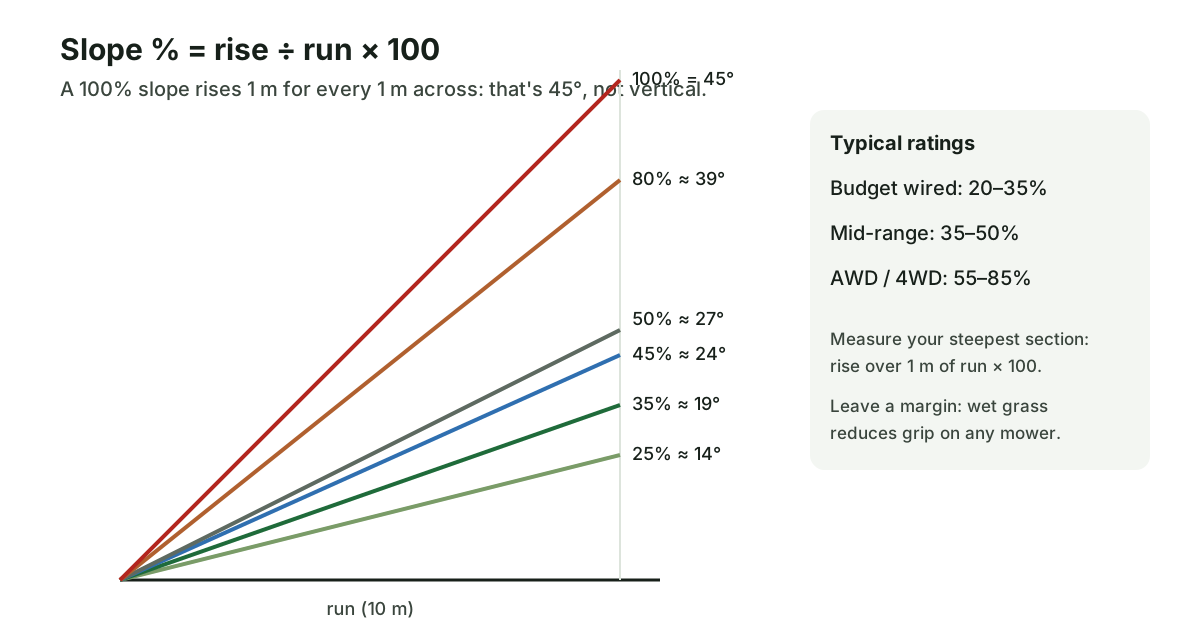
The conversion isn't linear, which is why percentages can mislead. Here are the ratings you'll see most often:
- 25% is about 14°
- 30% is about 17°
- 35% is about 19°
- 40% is about 22°
- 45% is about 24°
- 50% is about 27°
- 60% is about 31°
- 70% is about 35°
- 80% is about 39°
- 100% is 45°
Going the other way: a 10° slope is about 18%, 15° is about 27%, 20° is about 36% and 30° is about 58%.
If you want to work it out yourself, degrees are the arctangent of the percentage divided by 100. On a phone calculator, that's the "tan⁻¹" button: type 0.45, press tan⁻¹ and you get about 24.2.
How to measure your lawn's slope
You don't need special kit. The easiest method uses a straight board and a spirit level:
- Find the steepest part of the lawn by eye, and the steepest bit near its edges.
- Lay a straight board or batten exactly 1 m long on the slope, pointing straight uphill.
- Keep the uphill end on the ground and lift the downhill end until the spirit level on top reads level.
- Measure the gap between the downhill end and the ground, in centimetres. That number is the slope in percent. A 30 cm gap is a 30% slope.
For long slopes, repeat at a few points: banks are often steeper at the top or bottom than in the middle. Phone inclinometer apps also work; lay the phone on a straight board rather than directly on bumpy grass, and check whether the app shows degrees or percent.
Measure across the slope too. If the mower has to travel sideways along a bank, the cross-slope matters as much as the uphill one.
What current mowers are rated for
The ratings manufacturers publish vary widely:
- Small wired and budget mowers: often 25% to 35%. The Flymo EasiLife GO is rated for 25%.
- Mainstream two-wheel-drive wire-free mowers: commonly 30% to 50%.
- All-wheel drive and four-wheel drive: from about 60% upwards. The Mammotion LUBA 3 AWD is rated for 80%, the Husqvarna Automower 435X AWD NERA for 70%, and the Navimow X4 and Kress EyePilot 4×4 for 84%.
- The top of the range: the Lymow One Plus, a tracked mower for large grounds, is rated at 100%.
| Model | Price from | Max lawn | Navigation | Max slope | Score |
|---|---|---|---|---|---|
 Lymow One Plus Lymow One Plus | £2,799Out of stock | 7,001 m² | Hybrid (RTK + vision/LiDAR) | 100% | 8.1 |
 Kress EyePilot 4×4 RTKn Kress EyePilot 4×4 RTKn | £1,749 | 10,000 m² | Hybrid (RTK + vision/LiDAR) | 84% | 8.4 |
 Segway Navimow X4 Series Segway Navimow X4 Series | £2,199 | 5,000 m² | Hybrid (RTK + vision/LiDAR) | 84% | 8.8 |
 Worx Landroid Vision Cloud 4WD Worx Landroid Vision Cloud 4WD | £1,649.99 | 4,000 m² | Hybrid (RTK + vision/LiDAR) | 84% | 8.0 |
 MammotionMammotion LUBA 2 AWD MammotionMammotion LUBA 2 AWD | £1,699 | 10,000 m² | Hybrid (RTK + vision/LiDAR) | 80% | 8.8 |
| MammotionMammotion LUBA 3 AWD | £1,999 | 5,000 m² | Hybrid (RTK + vision/LiDAR) | 80% | 8.8 |
| MammotionMammotion LUBA mini 2 AWD | £1,249 | 1,500 m² | Hybrid (RTK + vision/LiDAR) | 80% | 8.0 |
 Husqvarna Automower 435X AWD NERA Husqvarna Automower 435X AWD NERA | £4,769.10 | 5,000 m² | Network RTK | 70% | 7.5 |
Why ratings are a best case
A manufacturer's slope figure generally describes what the mower can manage in good conditions. Real gardens are harder:
Wet grass. Wet grass reduces grip on any mower, and in the UK the lawn is damp for much of spring and autumn. A mower that climbs a bank on a dry July afternoon may slip on the same bank on a dewy October morning.
Turning and side slopes. Climbing straight up is easier than turning on a slope or driving across it. Mowers that mow in straight lines turn at the end of every pass, and some will cross a slope sideways.
Edges. Some manufacturers publish a lower limit for slopes along the boundary than inside the lawn. Husqvarna, for example, distinguishes the two. Near the edge the mower has to turn and stop precisely, and a slide there can take it off the lawn.
Surface. Bumpy, mossy or thin turf gives less grip than a dense, healthy lawn. Soft ground after rain can also rut.
How much margin?
There's no official figure, but as a rule of thumb, choose a mower rated at least 10 percentage points above your steepest slope, and more if that slope is at the edge of the lawn, often wet, or has to be crossed sideways. If your steepest bank is 35%, a 45% mower is a sensible minimum; a mower rated exactly 35% will probably struggle in wet weather.
Drive systems and grip
- Two-wheel drive (rear wheels driven, a castor or free wheel at the front) is the norm. Fine on flat and gently sloping lawns.
- All-wheel or four-wheel drive drives every wheel, keeping grip when weight shifts on a slope. These mowers tend to be heavier and more expensive, and some are louder.
- Tracks spread the load further; they're rare and mostly found on large-grounds machines.
Wheels matter too. Some brands sell terrain kits, spiked wheels or wheel brushes to improve grip and keep treads clean. Check what's available for the model you're considering in our accessories section.
Slopes, drops and safety
Slope ratings are about climbing, not about what's beyond the edge. Take extra care with:
- Drops and retaining walls. Keep the boundary well back from any drop so a slipping mower can't go over. A physical barrier, such as a low edge or fence, is safer than relying on the boundary alone.
- Ponds and water. Exclude them with a generous margin, and consider a physical barrier.
- Steps and paths at the bottom of a bank. A mower that slides may end up on them.
If part of a lawn is simply too steep, exclude it and cut it by hand or with a strimmer. That's often cheaper than buying a much more expensive mower just for one bank.
Looking after a sloping lawn
- Pause in heavy rain using the rain sensor or weather setting, so the mower isn't spinning its wheels on wet turf.
- Vary the mowing direction if the app allows, to avoid wheel ruts on the same line.
- Keep the wheels clean, as caked mud reduces grip.
- Raise the cutting height slightly on steep areas if the mower scalps the crest of a bank.
Next steps
Measure your steepest slope, add your margin, and then filter by it with our mower finder. Our best robot mowers for slopes page picks the strongest options at different budgets. If your garden has slopes and several separate areas, read our guide to complex gardens as well.
Frequently asked questions
What is a 45% slope in degrees?
About 24 degrees. Slope percentage is the rise divided by the horizontal distance, times 100, so a 45% slope rises 45 cm for every metre across. A 100% slope is 45 degrees.
How do I measure the slope of my lawn?
Rest one end of a straight 1 m board on the slope, pointing straight uphill, and hold it level with a spirit level. Measure the gap between the downhill end of the board and the ground in centimetres. That number is the slope percentage. Measure the steepest part of the lawn and near the edges.
Can a robot mower cut a steep bank?
Some can. Most two-wheel-drive mowers are rated between about 25% and 50%. All-wheel-drive models go much higher, with several current models rated at 70% or more. Leave a margin below the rating for wet grass and turns.
What happens if my lawn is steeper than the mower's rating?
The mower may lose grip, slide, get stuck or refuse to climb, and it can tear the turf as its wheels spin. On a bank above a drop, a sliding mower can go over the edge. Choose a model rated well above your steepest slope, or exclude that area.
Do robot mowers damage sloping lawns?
They can scuff the turf if the wheels slip, especially on wet, soft ground. All-wheel drive, the right wheels and pausing the mower in heavy rain all reduce the risk.
In this guide
Models mentioned in this guide
With today’s lowest UK price and our score.

Flymo EasiLife GO
- Up to 500 m²
- Perimeter wire
- 25% slopes
Husqvarna Automower 435X AWD NERA
- Up to 5,000 m²
- Network RTK
- 70% slopes
MammotionMammotion LUBA 3 AWD
- Up to 5,000 m²
- Hybrid (RTK + vision/LiDAR)
- 80% slopes
Segway Navimow X4 Series
- Up to 5,000 m²
- Hybrid (RTK + vision/LiDAR)
- 84% slopes
Kress EyePilot 4×4 RTKn
- Up to 10,000 m²
- Hybrid (RTK + vision/LiDAR)
- 84% slopes
Worx Landroid Vision Cloud 4WD
- Up to 4,000 m²
- Hybrid (RTK + vision/LiDAR)
- 84% slopes
Mower finder
Not sure which mower fits your garden?
Tell us your lawn size, slopes, trees and budget. The finder filters every current model down to the ones that fit, and explains why.
Measure your lawn on a map