Guide
Perimeter wire vs wire-free robot mowers
Perimeter-wire mowers are cheaper for a given lawn size and don't depend on satellite or mobile signal, but the wire takes effort to lay and can be cut. Wire-free mowers are quicker to set up and easy to change, and mow in neat lines, but depend on a clear sky view, mobile or Wi-Fi coverage, or cameras and LiDAR. Here's how to choose.

The short answer
Choose a perimeter-wire mower if your lawn is fairly simple, you're happy to spend a day installing it, and you want the lowest price or you have lots of big trees, tall buildings or poor mobile signal. Choose a wire-free mower if you want quick setup, expect to change the layout, have several lawns to link, or simply don't want wire in the garden, and your garden suits the navigation type you pick.
How each type works
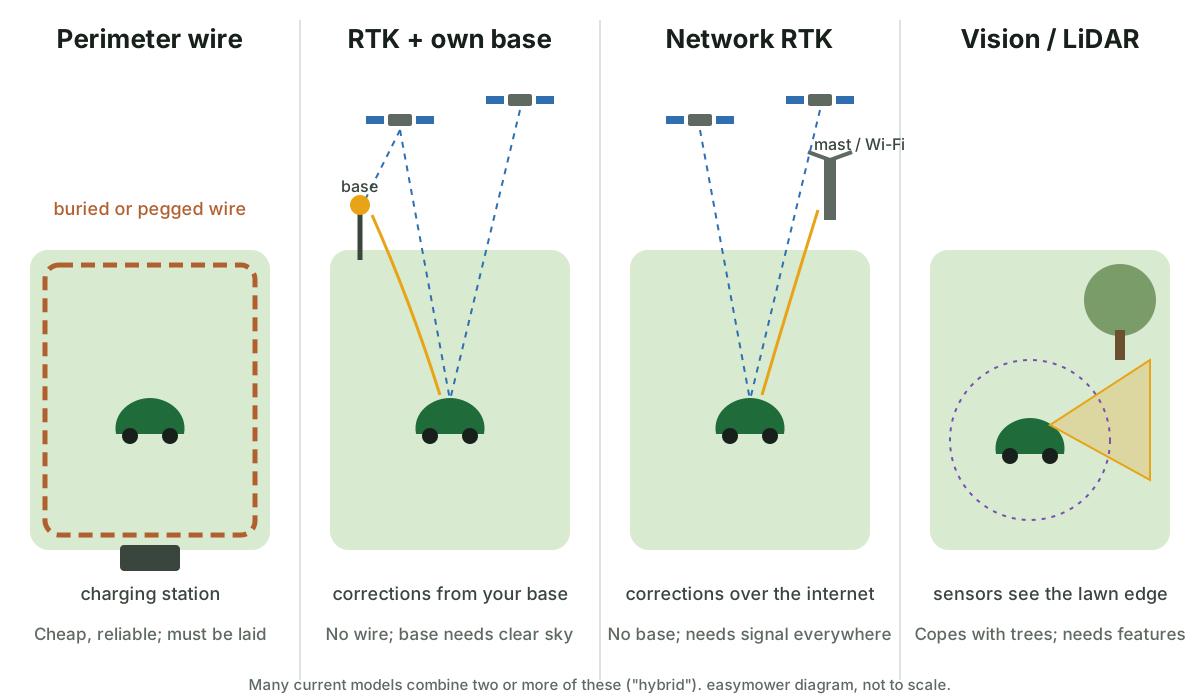
Perimeter wire. You lay a thin wire around the edge of the lawn, and around beds, ponds and trees you want the mower to avoid. The charging station sends a weak signal round the loop. The mower senses the wire and turns back. Many wired mowers also use a separate guide wire to find their way home or through a narrow passage.
Wire-free. The mower works out where it is without a wire, using one or more of:
- RTK satellite positioning, corrected by a base station in the garden or over a mobile or Wi-Fi connection (network RTK);
- cameras that recognise grass and obstacles;
- LiDAR, a laser scanner that maps walls, fences and trees.
You define the lawn by driving the mower round the edge in an app, or on some camera models by letting it find the edge itself. We explain the differences in RTK vs vision vs LiDAR.
Side by side
Installation
- Wired: pegging or burying wire around every edge and obstacle. Our installation guide walks through it. For an average garden, allow a day.
- Wire-free: place the charging station (and a base station, if needed), then map the lawn in the app. Often an hour or two.
Changing the layout
- Wired: moving a bed or adding a path means lifting and re-laying wire.
- Wire-free: redraw the boundary or add a no-go zone in the app.
Where it struggles
- Wired: cut wires (edging spades, scarifiers, moles, foxes), and very long or complex loops.
- RTK: dense tree cover, tall buildings close by, and gaps in mobile or Wi-Fi coverage for network RTK.
- Vision: low light, strong shadows, and lawns that blend into gravel or mossy borders.
- LiDAR: big, open areas with few fixed features for it to measure against.
Mowing pattern
- Wired: usually random, criss-crossing the lawn over several days. Some models add more systematic modes.
- Wire-free: usually neat parallel lines, with the angle changed between sessions.
Several lawns and passages
- Wired: possible with guide wires and careful passage layout, but fiddly.
- Wire-free: most apps handle multiple zones and virtual paths between them; some also support separate maps.
Price
- Wired: typically the cheapest way to cover a given area.
- Wire-free: usually more, though entry-level models now start under £1,000.
The case for perimeter wire
Wire is a proven technology. Once it's in and working, it's predictable: the mower doesn't care about trees, clouds, satellites or mobile networks. That matters in many UK gardens, where tall hedges, mature trees and close-set houses can all block the sky.
It's also the budget option. Mowers such as the Kress Mission and Husqvarna Automower 310 Mark II use wire, and the Kress starts at RRP £549.
The downsides are the installation effort and the vulnerability of the wire. The wire is visible for a few weeks until the grass grows over it. Cutting it with an edging spade or scarifier stops the mower until you find the break and join it. If you like to reshape beds, every change means moving wire.
| Model | Price from | Max lawn | Navigation | Max slope | Score |
|---|---|---|---|---|---|
 Parkside (Lidl) Parkside 20V Robot Lawnmower (PMRA 20-Li) Parkside (Lidl) Parkside 20V Robot Lawnmower (PMRA 20-Li) | £149.99RRP | 500 m² | Perimeter wire | 47% | 6.5 |
 Einhell FREELEXO Einhell FREELEXO | £309.98 | 500 m² | Perimeter wire | 35% | 6.2 |
 Worx Landroid M Worx Landroid M | £349.99 | 500 m² | Perimeter wire | 35% | 6.3 |
 Flymo EasiLife GO Flymo EasiLife GO | £419 | 500 m² | Perimeter wire | 25% | 6.0 |
 GARDENA SILENO minimo GARDENA SILENO minimo | £429 | 500 m² | Perimeter wire | 25% | 5.9 |
 Honda Miimo HRM 1000 to 4000 Honda Miimo HRM 1000 to 4000 | £474 | 4,000 m² | Perimeter wire | 47% | 6.7 |
The case for wire-free
Wire-free mowers are much quicker to set up and far easier to live with if your garden changes. You can add a no-go zone around a new flowerbed or a paddling pool in seconds. Most mow in straight lines, which many owners prefer the look of, and they tend to cover the lawn more efficiently than random mowing.
The catch is that each navigation type has conditions it needs:
- RTK mowers need a good view of the sky. Satellite signals weaken under trees and bounce off tall walls, which can make positioning unreliable in those areas.
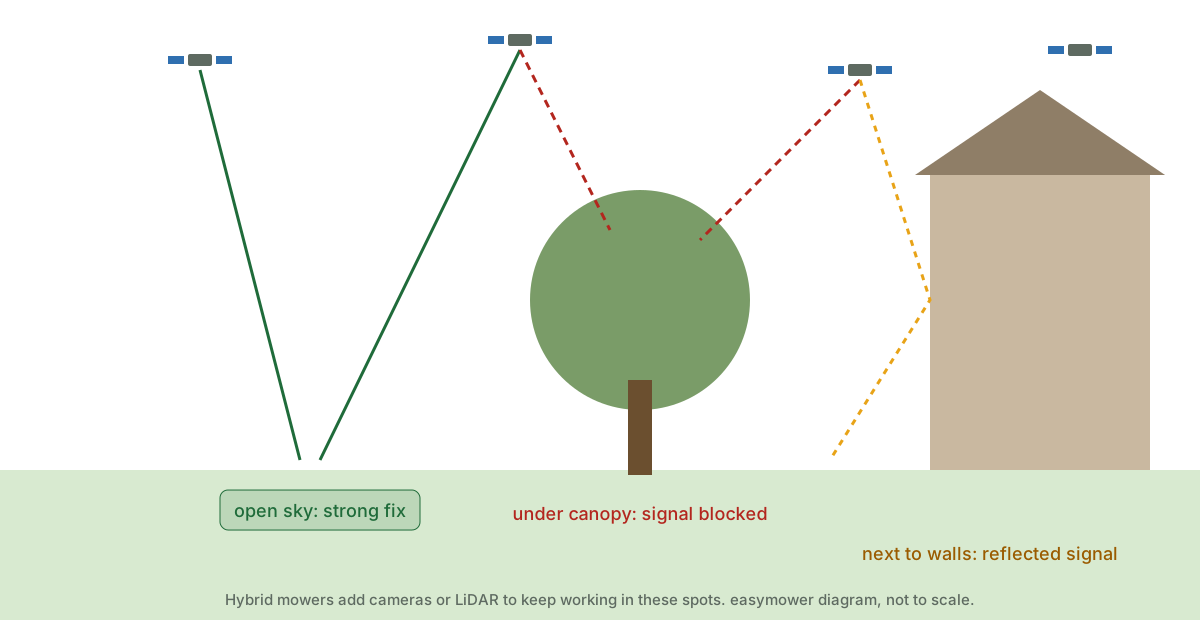
- Network RTK mowers also need mobile data or Wi-Fi across the lawn, or at least enough of it. See network RTK and 4G.
- Camera mowers need reasonable light and a lawn edge they can see.
- LiDAR mowers need fixed features within range to measure against.
Many current models combine methods to cover each other's gaps: for example, the Worx Landroid Vision Cloud uses network RTK with cameras, and the Navimow i2 LiDAR pairs LiDAR with a camera.
| Model | Price from | Max lawn | Navigation | Max slope | Score |
|---|---|---|---|---|---|
 LawnMaster OcuMow 16 LawnMaster OcuMow 16 | £229.99 | 300 m² | Vision (camera) | 35% | 5.9 |
 Bosch VISIMOW18V Bosch VISIMOW18V | £299.98 | 200 m² | Vision (camera) | 35% | 5.7 |
| LawnMaster OcuMow AMB16 | £379.99 | 600 m² | Vision (camera) | 35% | 6.8 |
 Ecovacs GOAT O RTK (O600 RTK / O800 RTK) Ecovacs GOAT O RTK (O600 RTK / O800 RTK) | £449 | 800 m² | RTK (own base station) | 45% | 7.5 |
| LawnMaster OcuMow 18 | £499.99 | 800 m² | Vision (camera) | 35% | 6.9 |
| Einhell FREELEXO CAM | £579.95 | 500 m² | Vision (camera) | 25% | 6.4 |
When one model is both
Some ranges blur the line. Husqvarna sells the Husqvarna Automower 310E NERA in two versions under the same name: a wire-free version using satellite positioning and an earlier version that uses wire by default. The data we hold lists its boundary types as Network RTK / Perimeter wire, so check the article number and description carefully before buying. Some wire-free mowers can also use a short length of wire or magnetic strip in problem spots, and some wired models support an add-on for satellite navigation.
Which suits your garden?
Lean towards wire if:
- the lawn is a simple shape with few beds;
- you have lots of mature trees over the lawn, or it's hemmed in by tall buildings;
- mobile signal is weak and you don't want a base station;
- budget matters most and you're happy to spend a day installing it.
Lean towards wire-free if:
- you have several lawns or want to change the layout often;
- installing wire would be hard, for example with lots of hard edges, paving or shallow soil over rubble;
- you want straight-line mowing and app-based zones;
- your lawn has a reasonably open sky, good mobile or Wi-Fi coverage, or features a LiDAR or camera mower can use.
For hedgehogs and wildlife, neither type is inherently safer. What matters is obstacle detection and, above all, mowing in daylight. See robot mowers and hedgehogs.
Next steps
If your garden has multiple areas or narrow passages, read our guide to complex gardens and see our best mowers for complex gardens. For a shortlist tailored to your lawn, try the mower finder. Our hubs list every current wire-free and wired model.
Frequently asked questions
Can I convert a wired robot mower to wire-free?
Usually not. A few ranges offer an upgrade: Husqvarna sells an add-on that lets some of its wired NERA models use satellite positioning instead. Most wired mowers lack the hardware, so going wire-free means buying a new mower.
Does perimeter wire have to be buried?
No. Most people peg it on the surface, and within a few weeks the grass grows over it. Burying it a little below the surface protects it from scarifiers, edging tools and animals, and is worth doing if you plan to scarify or aerate.
Do wire-free mowers work under trees?
It depends on the type. Satellite-only (RTK) mowers can lose accuracy under dense trees and beside tall buildings. Models that add cameras or LiDAR, or rely on them entirely, generally cope better. A wired mower is not affected at all.
Which is more reliable, wired or wire-free?
Wired systems are mature and predictable once installed; their main failure is a cut wire. Wire-free systems avoid that but depend on signal, light or visible landmarks, so reliability varies more with the garden. Newer brands also have shorter track records.
Are wire-free robot mowers more expensive?
Generally yes, at the same rated area, though the gap has narrowed and there are now wire-free models under £1,000. Wired mowers remain the cheapest way to cover a simple lawn.
In this guide
Models mentioned in this guide
With today’s lowest UK price and our score.

Husqvarna Automower 310 Mark II
- Up to 1,000 m²
- Perimeter wire
- 40% slopes
GARDENA SILENO life
- Up to 1,250 m²
- Perimeter wire
- 35% slopes

Kress Mission
- Up to 2,500 m²
- Perimeter wire
- 35% slopes
Husqvarna Automower 310E NERA
- Up to 1,500 m²
- Network RTK
- 30% slopes

Segway Navimow i2 LiDAR
- Up to 2,000 m²
- LiDAR
- 45% slopes
Worx Landroid Vision Cloud
- Up to 1,800 m²
- Hybrid (RTK + vision/LiDAR)
- 30% slopes
Mower finder
Not sure which mower fits your garden?
Tell us your lawn size, slopes, trees and budget. The finder filters every current model down to the ones that fit, and explains why.
Measure your lawn on a map