Guide
RTK vs vision vs LiDAR navigation explained
Wire-free robot mowers find their way using satellite positioning (RTK), cameras, LiDAR, or a mix. RTK is precise on open lawns but weak under trees and beside tall buildings; cameras need light and a visible lawn edge; LiDAR measures fixed features and works in the dark but needs something to measure against. Hybrids combine them. Here's how each works and which suits your garden.

The short answer
- RTK uses satellites plus correction data to pinpoint the mower to within a few centimetres. It's excellent on open lawns and big areas, but loses accuracy under trees and close to tall buildings.
- Vision uses cameras to recognise grass, edges and obstacles. It needs no satellites or base station, but needs reasonable light and a clear visual boundary.
- LiDAR uses a spinning or solid-state laser scanner to measure distances to walls, fences, trees and other fixed features, building a map it can locate itself in. It works in poor light and under trees, but needs things to measure against.
- Hybrids combine two or three of these so one covers the others' weak spots. Most premium wire-free mowers are now hybrids.
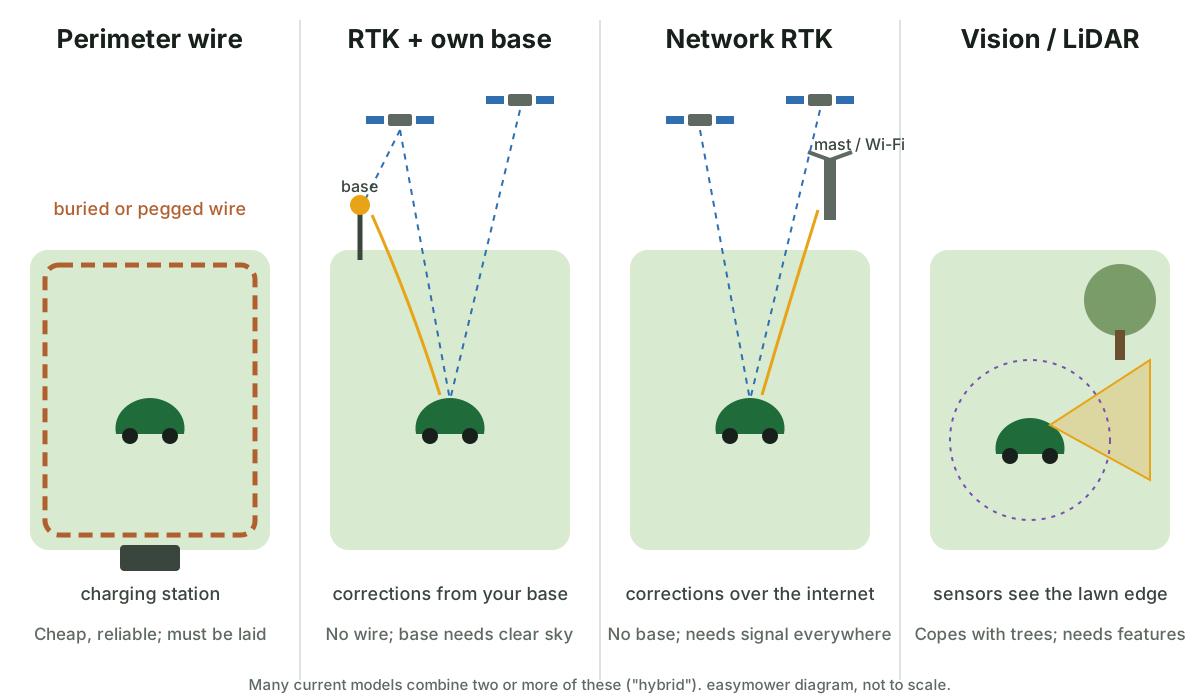
RTK: satellites with corrections
Every satellite-guided mower starts with GNSS, the general name for GPS and the other satellite systems. On its own, GNSS is accurate to a few metres: fine for finding a street, useless for keeping a mower off your flowerbed.
RTK (real-time kinematic) fixes that. A reference receiver at a known, fixed position watches the same satellites, works out the errors in the signals and sends corrections to the mower, which can then position itself to within a few centimetres. The corrections come from one of two places:
- Your own base station, a small antenna on a pole, wall or roof in or near the garden. The Ecovacs GOAT O RTK and the Navimow i Series use one.
- Network RTK, where corrections arrive over the internet from a network of reference stations, via the mower's own 4G connection or your Wi-Fi. There's nothing to mount. The Navimow i2 AWD and Stiga A v range work this way. Our network RTK and 4G guide covers the coverage and subscription side.
Where RTK struggles
RTK needs a clear view of a good slice of sky. Anything that blocks or reflects satellite signals degrades it:
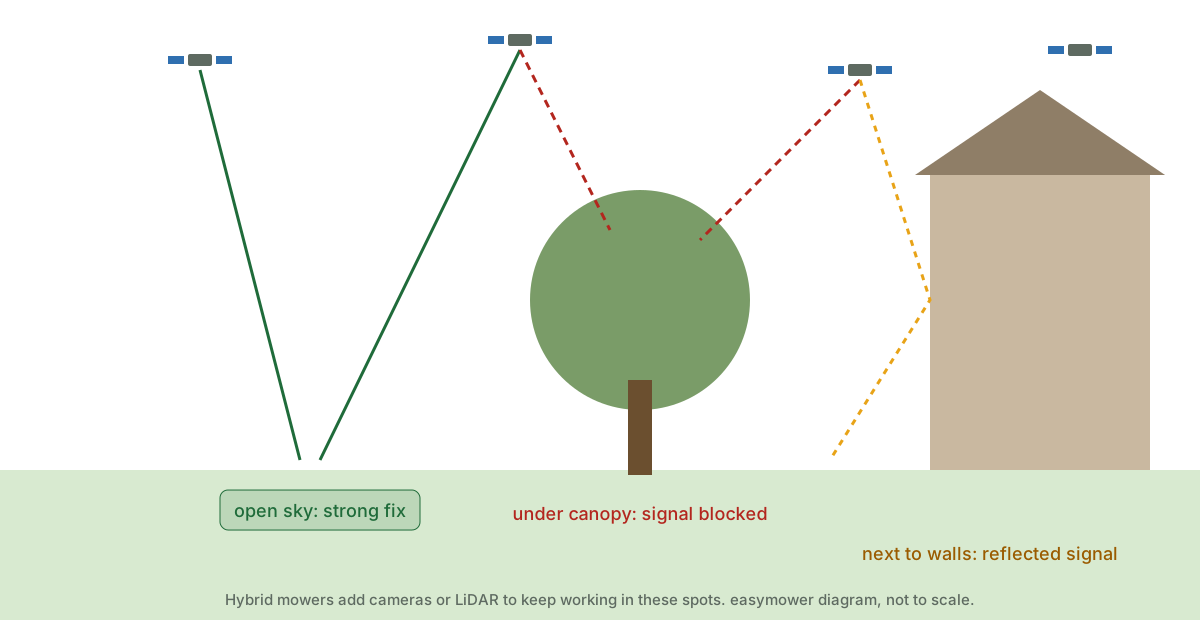
- Trees, especially large deciduous trees in full leaf and dense evergreens.
- Tall buildings and walls close to the lawn, which block part of the sky and can bounce signals, confusing the receiver.
- Narrow side passages between houses, common in UK terraces and semis.
When accuracy drops, a satellite-only mower may slow down, stop, or refuse to mow that area. Positioning the base station with a clear view of the sky, usually as high as practical, helps; so does choosing a hybrid.
RTK suits: open lawns, large gardens and paddocks, lawns with few trees, and gardens where you want precise straight-line mowing.
Vision: cameras that see the lawn
Camera-guided mowers use one or more cameras and image-recognition software to tell grass from everything else: paths, beds, walls, toys, pets. Some drive the edge in a mapping run; others simply stay on what they recognise as lawn. Examples include the eufy E15, which eufy says uses stereo cameras, and the Bosch VISIMOW18V.
Strengths: no wire, no base station and no signal needed, so setup is simple. Cameras also double as obstacle detection, and some models are trained to recognise specific objects.
Weak spots:
- Light. Cameras need reasonable daylight. Dusk, deep shade and harsh low sun with long shadows can all cause trouble, and many vision mowers stop in the dark.
- Unclear edges. A lawn that fades into a mossy gravel path, a wildflower strip or a bed of low ground cover gives the camera less to go on. A crisp edge helps.
- Dirty lenses. Grass, mud and rain on the camera reduce performance, so they need occasional wiping.
Vision suits: small and medium gardens with clear lawn edges, including tree-heavy and walled gardens where RTK struggles.
| Model | Price from | Max lawn | Navigation | Max slope | Score |
|---|---|---|---|---|---|
 LawnMaster OcuMow 16 LawnMaster OcuMow 16 | £229.99 | 300 m² | Vision (camera) | 35% | 5.9 |
 Bosch VISIMOW18V Bosch VISIMOW18V | £299.98 | 200 m² | Vision (camera) | 35% | 5.7 |
| LawnMaster OcuMow AMB16 | £379.99 | 600 m² | Vision (camera) | 35% | 6.8 |
| LawnMaster OcuMow 18 | £499.99 | 800 m² | Vision (camera) | 35% | 6.9 |
 Einhell FREELEXO CAM Einhell FREELEXO CAM | £579.95 | 500 m² | Vision (camera) | 25% | 6.4 |
 TerraMow Mini 500 TerraMow Mini 500 | £656Out of stock | 500 m² | Vision (camera) | 32.5% | 6.7 |
LiDAR: measuring the garden with lasers
LiDAR sends out laser pulses and times their reflections to measure the distance to everything around it, building a 3D picture of the garden. The mower recognises where it is by matching what it sees now with its stored map of fixed features: the house, fences, sheds, tree trunks. Examples include the Dreame A1 Pro and the Ecovacs GOAT O1200 LiDAR PRO.
Strengths: works under trees and next to buildings, exactly where RTK is weakest; doesn't need daylight; no base station or signal; also good at spotting obstacles.
Weak spots:
- Open spaces with nothing to measure. In a big, open lawn far from walls or trees, a LiDAR mower has few landmarks. Manufacturers quote a maximum range, and features beyond it don't help.
- Changing surroundings. Parked cars, garden furniture and hedges that grow or are cut back change the view. Good software copes with this, but big changes may need re-mapping.
- Price and weight. LiDAR hardware adds cost, though LiDAR models are now available at mid-range prices.
LiDAR suits: typical suburban gardens bounded by fences, walls and buildings, including those with trees and tall neighbouring houses.
| Model | Price from | Max lawn | Navigation | Max slope | Score |
|---|---|---|---|---|---|
 Dreame A1 Pro Dreame A1 Pro | £699 | 2,000 m² | LiDAR | 45% | 8.1 |
 Ecovacs GOAT O1200 LiDAR PRO Ecovacs GOAT O1200 LiDAR PRO | £949 | 1,200 m² | LiDAR | 45% | 7.9 |
 Segway Navimow i2 LiDAR Segway Navimow i2 LiDAR | £999 | 2,000 m² | LiDAR | 45% | 8.2 |
Hybrids: combining methods
Because each method fails in different places, many mowers now combine them. Two broad patterns:
- RTK plus cameras. The cameras handle obstacle avoidance and help the mower keep going when the satellite fix is weak. Kress, Worx, Husqvarna's newer camera-equipped Automowers and several Navimow models use this approach.
- RTK plus LiDAR plus cameras. The most complete setup. The Mammotion LUBA 3 AWD 3000 and 5000 combine network RTK with LiDAR and cameras, for example.
Hybrids are the safest choice for mixed gardens, open in some places and shaded in others. They cost more, and the software doing the combining matters as much as the hardware. Watch for models where different sizes use different navigation: Mammotion's LUBA 3 AWD 1500 has no network RTK, unlike the larger versions.
Obstacle detection is a separate question
Don't confuse navigation (knowing where the mower is) with obstacle avoidance (not hitting things). A mower can navigate by RTK and still use a camera to spot a hedgehog or a toy. Or it may rely only on its bump sensor. Check what each model uses: our model pages list the obstacle-avoidance technology the manufacturer states. No system catches everything, so clear the lawn and mow in daylight. See robot mowers and hedgehogs.
Which suits your garden?
- Open lawn, low fences, few trees: RTK or network RTK works well and gives precise lines.
- Walled or fenced suburban garden with tall houses close by: LiDAR, vision or a hybrid.
- Lots of mature trees over the lawn: LiDAR, vision or a hybrid, or consider a wired mower.
- Large rural plot with patchy mobile signal: RTK with its own base station, a hybrid, or wire.
- Lawn edges that blend into gravel or planting: avoid vision-only unless you're happy to sharpen the edges; RTK or LiDAR handle this better.
- Several separate lawns: most wire-free types handle this; see complex gardens.
If you're still weighing wire against wire-free, read perimeter wire vs wire-free. For recommendations, try the mower finder or browse all wire-free models.
Frequently asked questions
Which navigation type is most accurate?
On an open lawn with a clear sky, RTK is the most precise, typically to within a few centimetres. Near trees and buildings its accuracy can drop, and LiDAR or vision may do better there. That's why many premium mowers combine RTK with cameras or LiDAR.
Do camera (vision) robot mowers work in the dark?
Mostly not. Camera navigation needs reasonable light, and many vision mowers stop at dusk. Some add infrared or other sensors for low light. Daytime mowing is better for hedgehogs anyway.
Does LiDAR work at night?
Yes. LiDAR measures distances with its own laser light, so it doesn't depend on daylight. That doesn't make night mowing a good idea in UK gardens, because of hedgehogs and other wildlife.
Do I need an RTK base station?
Only for RTK mowers that don't use network RTK. Some mowers come with a base station that you mount in the garden; network RTK models get corrections over 4G or Wi-Fi instead. Camera and LiDAR mowers don't use one at all.
Is GPS alone good enough for a robot mower?
No. Ordinary satellite positioning, like a phone's, is only accurate to a few metres. RTK corrections are what bring it down to centimetres, which is needed to follow a lawn edge.
In this guide
Models mentioned in this guide
With today’s lowest UK price and our score.
Ecovacs GOAT O RTK (O600 RTK / O800 RTK)
- Up to 800 m²
- RTK (own base station)
- 45% slopes
Segway Navimow i2 AWD
- Up to 1,000 m²
- Network RTK
- 45% slopes

eufy Robot Lawn Mower E15
- Up to 800 m²
- Vision (camera)
- 32.5% slopes
Dreame A1 Pro
- Up to 2,000 m²
- LiDAR
- 45% slopes
Ecovacs GOAT O1200 LiDAR PRO
- Up to 1,200 m²
- LiDAR
- 45% slopes
 Mammotion
Mammotion LUBA 3 AWD
- Up to 5,000 m²
- Hybrid (RTK + vision/LiDAR)
- 80% slopes
Mower finder
Not sure which mower fits your garden?
Tell us your lawn size, slopes, trees and budget. The finder filters every current model down to the ones that fit, and explains why.
Measure your lawn on a map