Robot mower passage width checker
 Tom
Enter the narrowest point of the gate, path or gap your mower would have to drive through, and the checker lists the current mowers whose makers say they can use it. Mowers with no published figure are listed separately by body width.
How to use the checker
- Find the narrowest point on the route between the lawns. Walk it with a tape measure.
- Measure the clear width at about 30 cm above the ground, the height of the mower's body. Include anything that sticks out at that height: gateposts, hinges, downpipes, bins, hose reels, plants that flop over the edge in summer.
- Drag the slider or type the width in centimetres, or start from one of the presets. The drawing and the list of mowers update as you go.
- Choose what's either side of the gap (posts or walls, a hedge, or flower beds) for tips on measuring that kind of gap.
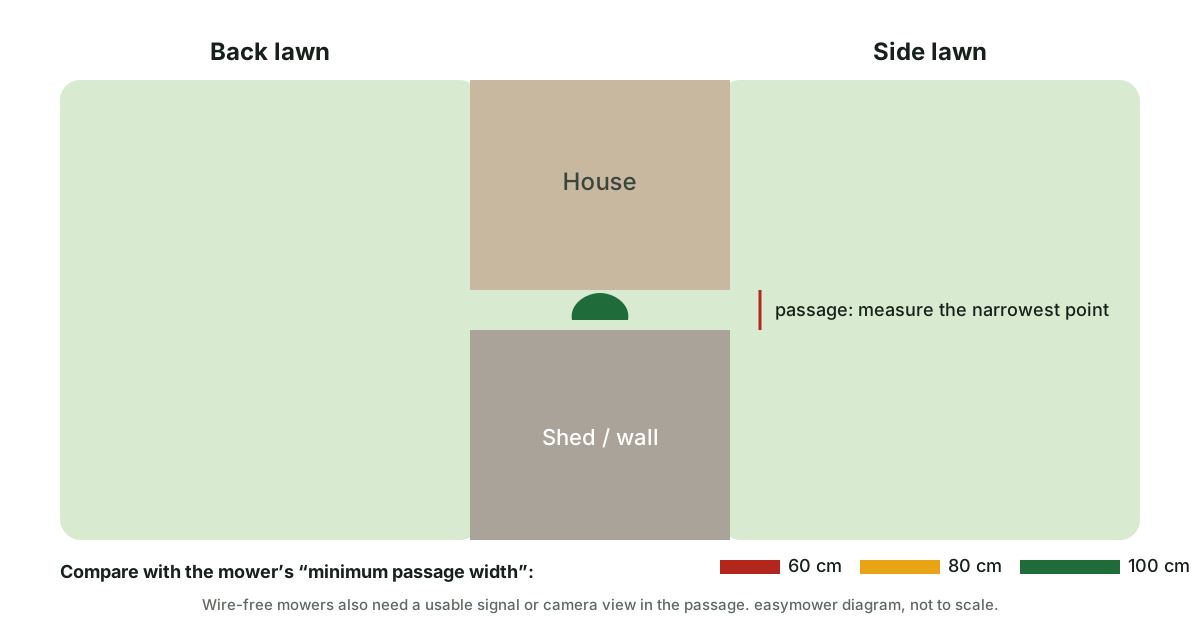
The drawing shows the gap from above, to scale, with a typical mower driving through it. The shaded strip is the width its maker asks for; for a wired mower the two dashed lines are the boundary wires. Pick another mower under Mower in the drawing, or tap Draw on any result, to see how it compares with your gap.
If the passage has a step, a kerb or a gravel or paved surface, note that too. A gap can be wide enough and still be impassable for a mower that can't climb a 5 cm lip or loses its position on paving.
Reading the result
The checker compares your gap with each manufacturer's published minimum passage width:
- Room to spare means your gap is at least 10 cm wider than the minimum.
- Tight means it's wider than the minimum by less than 10 cm. The figure is a best case for a flat, clear, straight passage, so a tight fit may need the plants cutting back or the route adjusting.
- Too narrow mowers are listed in a collapsed section, with how many centimetres short the gap is.
Under the drawing, each dot on the scale is a current mower at its published minimum, so you can see at a glance how close your gap is to the bulk of the market. Where versions of a mower have different figures, the card names the versions it applies to.
Wired mowers: wire to wire
For mowers that use a boundary wire, the published minimum is usually the distance between the two runs of wire through the passage, not the space between walls or fences. The wire is pegged in from each edge, by a distance the installation manual specifies, so the physical gap has to be wider than the figure. The results mark these "between wires".
Wired mowers often need a guide wire through a narrow passage as well. Our installation guide explains how that works.
Mowers with no published minimum
Most manufacturers don't publish a minimum passage width. For those, the checker shows the mower's body width from its published dimensions, and says whether that's narrower than your gap. That's a physical limit, not a recommendation: a mower 45 cm wide can't use a 50 cm gap in practice. Wire-free mowers in particular need extra space so their cameras, LiDAR or satellite fix can guide them through. Check the manual or ask the manufacturer before relying on a gap that's less than about twice the mower's width.
Where to go next
If the gap is too narrow for the mowers you like, you can widen it, or treat each lawn as a separate area and carry the mower. Our guide to complex gardens covers both, and best robot mowers for complex gardens has our picks for lawns split by paths and beds.
Frequently asked questions
How narrow a passage can a robot mower get through?
It depends on the model. The published minimums for current mowers range from about 55 cm to 120 cm. Many manufacturers don't publish one at all, so check the manual or ask before you rely on a narrow gap.
Why is the minimum passage so much wider than the mower?
The mower has to steer through the gap without touching the sides, find its way in and out, and for wire-free models keep its position as walls and hedges get in the way. Wired mowers also need space between the two runs of boundary wire so the signals don't confuse it.
What does minimum passage width mean for a wired mower?
For mowers with a boundary wire, the figure is usually the distance between the wire on one side of the passage and the wire on the other. The wire is laid some way in from each edge, so the gap itself needs to be wider. The installation manual gives the distances.
What if my gap is narrower than any mower needs?
Treat the lawns as separate zones and carry the mower between them, or widen the gap. Many mowers can store more than one map or zone, so carrying is a small job if the second lawn is mown less often.
Should I measure the gate or the path?
Measure the narrowest point the mower would drive through, at mower height. That's often a gatepost, a bin, a downpipe or plants that lean over the path in summer, not the path itself.
Next steps
Check how each mower handles narrow gaps and separate zones.
- Wire-free robot mowers
- Wired robot mowers
- The cheapest robot mowers worth buying
- The best robot lawn mowers for complex gardens
- The best robot lawn mowers for large gardens
- The best robot lawn mowers for slopes
- The best robot lawn mowers for small gardens
- The best robot lawn mowers under £1,000
- Robot mowers for multiple lawns, narrow passages and complex gardens
- Robot lawn mower installation: boundary wire and wire-free setup